Our team is prioritizing pedagogy and the overall reproducibility of Mapping Cemeteries in our Outreach and Publicity Plan. While several social media platforms and web tools provide wide opportunities for distribution, not all–or even most–are conducive to teaching the Digital Humanities (DH) skills and topic of Mapping Cemeteries.
We understand that our primary and secondary audiences value research, user design, user experience, and project design according to our analysis of their DH backgrounds and interests. Based on this, we determined a six-week campaign across Instagram, Facebook, SoundCloud, and TikTok were the best options for the priorities of our audience and reproducibility of Mapping Cemeteries following our review of popular and obscure digital platforms and tools. Outlined below are key areas of outreach that include milestones and protocols to be executed during our intended window of interaction with our audience.
Staff Responsible
lane v., Outreach Lead
Asma N., Audiovisual Modulation Lead, Outreach Support
Platforms
- Instagram
- Facebook
- SoundCloud
- TikTok
Timeline
Our Outreach team will run a six-week campaign on the reproducibility and awareness of Mapping Cemeteries’ humanistic investigations. The timeline for outreach was designed around the time constraints of the Spring 2021 semester and the time required to execute phase 1 during this 13-15 week window. The six-week window is imagined as an opportunity for a specific and targeted approach to our outreach milestones.
Protocol
- Accessibility: The entire time will have access to all platforms, although Asma will be taking the lead on SoundCloud and Facebook content. Both login and passwords for the accounts will be stored in a team document.
- Responses: Anyone on the team can respond to comments or converse in comment sections, but lane will take primary responsibility for ensuring comments are responded to within 24 hours of the comment being posted. If a comment pertains to a subject that another team member has specific knowledge or insight in, they may be requested to aid in the response.
- Troll Comments: With any social media presence, there is always a chance of being targeted by trolls or bots. If an inappropriate comment that has no relevance to the project is left under one of our posts, it will be flagged and removed by one of the team members.
- Tone: To best appeal to our intended audience of classmates and fellow academics, our social media presence will take a pedagogical approach with its posts. We do want to keep in mind the seriousness of our project’s subject matter, so the overall tone of our social media presence will be an intentional balance of educational and levitous.
Instagram and Facebook
For Instagram and Facebook we are focused on six weeks of posts starting on Week 7 of class (Spring Break):
- At least one Instagram post with photos and relevant information on each cemetery our project is focusing on:
- a historical cemetery that still exists as such
- a cemetery that was established/other
- a cemetery that was repurposed as a public park
- a cemetery that was repurposed and later rediscovered and exists again as such
- a war memorial
- At least one post advertising each of the three episodes of our project’s podcast
- Other posts may include TikTok videos, excerpts from articles, or other relevant information intended to encourage interaction or draw the attention of our audience.
Audio Roundtable, SoundCloud
Mapping Cemeteries will produce a limited, three-part audio series on phase 1 of the project hosted on SoundCloud. The first episode will introduce the team of DHers working on Mapping Cemeteries; episode two will introduce each of the five necropolitical investigations of Mapping Cemeteries; and the final episode will bring the team and listeners to an audio roundtable to disseminate Mapping Cemeteries and its overall intervention.
Mapping Cemeteries is built with accessibility in mind; we understand access is a broad category that centers ability and learning styles alike, among other important considerations. We care about this scope, especially as it concerns the twofold pedagogical and reproduction priority of our project. We recognize audio as an opportunity to address an area of design; or to capture and playback the bits–for example a DH tip for troubleshooting–that interest our audience in another useful format for learning. We also recognize audio as an opportunity to reach our audience with known and unknown visual impairments–and varying accesses to supportive resources–through our project’s outreach.
SoundCloud was selected as a primary hub for storing and manipulating audio data, and disseminating Mapping Cemeteries due to its reputation in audio hosting (storage), Rich Site Syndication (RSS) feed module, and playback features that do not require credentials (user registration) for our audience without an account.
Though this limited audio series will capture fragments of our project, it provides sentimental and intellectual insights to our process and relationship to our humanistic topic that would not be otherwise known, or pertinent to the key user-facing aspects of Mapping Cemeteries.
TikTok
The team is extremely interested in utilizing TikTok to attract the attention of our audience. Surprisingly, there is a significant amount of TikTok videos about digital humanities–most of them are in German. Before final dissemination, the goal is to post at least one to two videos discussing Mapping Cemeteries and the DH skills we’re using to build the project.
Expected Outcomes
Our primary goal is twofold: we want to prioritize the reproduction and pedagogical elements of Mapping Cemeteries for our audience. Our expectation is that they will be able to implement at least one key DH skill outlined in our outreach content; and to reproduce an element of Mapping Cemeteries that concerns user experience and/or project design.
For example, embedding audio is a DH skill that encompasses user experience and design and audiovisual modulation considerations. Our campaign could feature a three-part TikTok video series to teach this DH skill, informed by our Audiovisual Modulation, and User Experience and Design Leads, respectively, on how to accomplish (or to otherwise think about) this task.
- The first video can introduce the skill, its importance, and how it can be used for a key task of our project (to reproduce).
- Our Audiovisual Modulation Lead, Asma N., can develop instructions on how to record, edit, export, and upload an audio file to an audio source to generate an embedded code for the second video.
- Our User Experience and Design Leads, Lisa K. and Nadia E. can show how to embed the code on the backend of a website, or platform, relevant to Mapping Cemeteries to conclude the series.
Our Outreach Team and Lead, lane v., will ultimately review the content (with project management input) and modify the pedagogy for each task in an accessible and creative manner for our audience.
If our audience can learn one of our DH skills, the hope is for them to then implement it–or conceptualize how–to reproduce an element of our project in one of the aforementioned topic areas (user experience, project design, etc.). Get the skill, use it for a task.
Measure of Effectiveness
Our Leads, Asma N. and lane v. will develop a survey to measure the execution of our expected outcomes. We want to know if and how our audience’s interests were reflected in our overall project and how our choices facilitated our goals for expected outcomes.
Analytics
In addition to a survey, most of our intended platforms allow for analytics, or have DH tools that compensate. For instance, Mapping Cemeteries will need to establish an Instagram/Facebook business account to access its analytic feature, Instagram Insights. An alternative is Iconosquare, a free analytics tool designed to capture engagement data from Instagram and its parent company, Facebook. This digital tool, which can be discerned as one for DH in the case of Mapping Cemeteries, offers machine-learned, generated tips on how to improve our engagement. This tool generates analytics every 30 days, which means we’ll have access to two sets of analytic data within our 6-week window, should we use it.
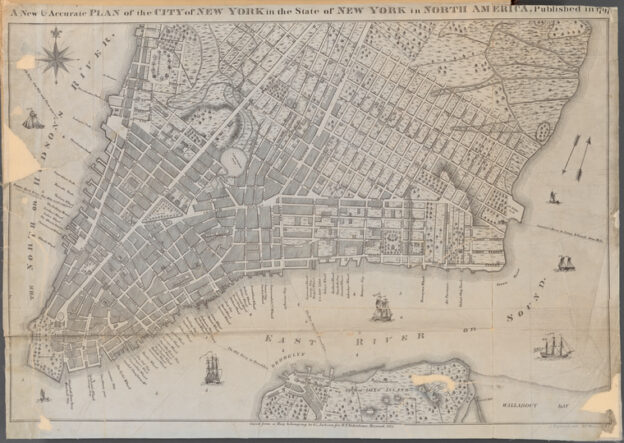
*Map of Manhattan from 1797; image from the New York Public Library digital archives.
*posted by lane, Asma, Nadia, Lisa, and Bri