Category Archives: Project Proposal

Reading Rebus Writing: Revised Project Proposal

The ubiquity of emojis in our digital chat conversations invites interrogation into rebus writing as a predecessor to the emoji and an interdisciplinary area of study, intersecting many aspects of digital humanities. By definition, an emoji is a pictogram representing an object; an ideogram representing an abstract concept; or an emoticon representing human emotion. Pre-dating emojis, a rebus uses a symbol to represent a sound, syllable, part of a word, or whole word, regardless of its meaning. Rebus writing combines visual elements with letters, words, and phonics to create puzzles which need to be deciphered and translated in order to understand their meaning. Coinciding with France’s invasion of Egypt and subsequent discovery of the Rosetta Stone in 1799, rebus writing enjoyed a resurgence as a form of playful and satirical expression in late 18th– early 19th-century Europe and America. Circulating in printed broadsides, advertisements, letters, reading exercises, bibles, picture puzzles, and newspaper games, rebus writing became distinct from its ancient origins and early modern functions, entering more expansively into the daily lives of children and adults as visual vernacular.

Reading Rebus Writing (RRW) is an online, visual archive of late 18th– early 19th-century European and American rebus ephemera, that includes research into their history and cultural uses.  While focusing predominantly on this period, the project leaves open possibilities to expand its temporal and geographical scope through additional visual artifacts, historical research, and multilingual examples. The project aims to make a core group of historical rebus ephemera accessible in an engaging, collaborative, and interactive format to scholars in diverse fields such as linguistics, history, education, communications, design studies, and visual arts, as well as members of the general public – opening up new possibilities for discovering how we see and interpret visual information. Each rebus puzzle will be treated as an interface of inquiry to conduct close reading experimentations, translations, and ambiguous interpretations by audience participants. RRW challenges the notion of traditional texts by using humanistic qualitative analysis, while also contributing to the history of language, visual literacy, and visual communication, connecting cuneiform and hieroglyphs to contemporary, digital emojis.

19th century Rebus Valentine Letter.

Left: 19th century Rebus Valentine Letter. John Johnson Collection, Bodleian Library, Oxford University.

Right: Detail with my interpretation. Does the meaning of the content change if the observer interprets the pictograms differently?

Enhancing the Humanities through Innovation

As a digital archive developed with WordPress, RRW will use existing digital repositories and institutional library holdings (example one, two, three) to curate a small selection of British and American rebus writing ephemera published in the late-18th and early-19th century for interpretation, translation, discourse, and experimentation. RRW will be based predominantly on the materials found in special collections and archives; these rebuses will have been unearthed during research performed specifically for this project and therefore will be previously unknown to a larger audience, in effect, having remained essentially hidden and undiscovered.  The goal is not to gather every example but to provide a digital playground for close reading experimentations and translations. Each rebus will be treated as an interface, a point where visual systems, typographic systems and interpretation meet. As one hovers a mouse over areas of the rebus, translated English words will appear, aiding in the interpretation of the content. If there are multiple interpretations, all possible words will appear. Since interpretations are based on humanistic analysis of the visual, a participant will be prompted to submit their interpretation, offer their point of view, leading to alternate meanings. There may also be instances where a pictogram cannot be identified by the project team, so audience submission will be encouraged: interested users might find a rebus that has not been solved and offer their own provisional solution for it. Their explanatory texts will then be published on the platform–this way the platform will continue to be a place for ongoing activities even after our course involvement ends.

Additionally, essays on the history of the rebus, cultural impact and its placement between the origin of writing and current-day smartphone emojis will be provided for context.

  • Can a visual vernacular be established for people of late 18th–early 19th-century Europe or America and if so, what is its cultural significance?
  • Does the appropriation of minority cultures by a dominant group impact the reading of the rebuses or their subject matter? And how does this cultural, visual appropriation affect the history and development of language and communication?
  • What conclusions about late 18th–early 19th-century European and American society can be posited from the way rebuses were drawn and where/how they were printed?
  • Can rebus writing, with its use of visual symbols and ambiguous interpretations, be considered a “text”? [“What makes a text a text—its susceptibility to varying levels of address—is a feature of book culture and the flexibility of the textual imagination” (Witmore)]
  • Does the mind’s conceptualization of image to phonology factor into both the difficulty and the ludic aspects of a rebus’s visual wordplay?

Environment Scan

RRW differs from a typical digital archive due to its reliance on the integration between the visual and textual qualities of the rebus artifacts – a visual symbol and its reading exist in a symbiotic relationship. Here are a few projects that share similar theoretical and physical, interactive characteristics:

  • The Global Medieval Sourcebook at Stanford University – for each artifact, a participant can see a parallel panel view for English language translations, side-by-side, line-by-line.
  • The First Six Books of the Elements of Euclid – Presents the text, in a format similar to the printed publication, with shapes that highlight areas of an accompanying diagram when clicked on.
  • Fabricus by Google Arts & Culture – Related to this field of inquiry, however, RRW is not interested in employing sophisticated machine-learning technology which may have biases present in their algorithms. Instead, the project will emphasize the “human” aspect of the digital humanities. While this method may yield inaccurate or inconsistent results, it is important to recognize that different users may interpret rebus writing in different ways. The variation of rebus puzzle solutions may reveal alternative ways users see visual symbols and make them aware of their own knowledge production as observer co-dependent and interpretative, actively constructed from the user’s observation and experience (Drucker).

Audiences

The first iteration of RRW will be disseminated through various channels related to the different audiences. The project team will reach out to departments at universities (linguistics, art history, communications, art and design, history, etc.) to attract academics and students who may be interested in the project for research or teaching.

To reach public general audiences, as well as some scholars, information about the project, along with images of the rebus ephemera will be posted on social media networks, along with a call to action to help us solve the puzzles by submitting translations. Project team members may also have access to mailing lists within their specialties.

Efforts will be made during the design and development phase to ensure the content is accessible, such as providing descriptive alt-text labels for all images and following to the greatest extent possible the 2021 ADA & WCAG accessibility standards and requirements. (ADA/WCAG)

Team / Skills

For the first iteration of the WordPress website (completed this semester) team members will establish criteria for the curation of rebus examples, decide how many are shown, offer interpretations, design and develop the website, perform outreach to audiences, and write essays for context.

Roles:

Patricia: Designer/Developer

Matt: Researcher / Analyst

Ostap: Researcher/Institutional Outreach

Bianca: Project Manager / Copy editor~fact checker

Rachel: Researcher / Developer

“Mapping” Cemeteries: Revised Proposal

Team Members and Roles

Name: Brianna Caszatt
Primary Role: Project Manager
Secondary Role: Web Development, Mapping
Cemetery: Cemetery that was repurposed as a public park

Name: lane vineyard
Primary Role: Outreach, Social Media
Secondary Role: Design
Cemetery: Cemetery that was repurposed and later rediscovered and exists again as such

Name: Lisa
Primary Role: Design, Testing
Secondary Role: Documentation and research
Cemetery: War memorial

Name: Asma N.
Primary Role: Audio, Text Analysis
Secondary Role: Accessibility, Data Storage
Cemetery: Cemetery that was repurposed for private development

Name: Nadia El Mouldi
Primary Role: Web Development, Mapping
Secondary Role: Social Media, Outreach
Cemetery: Historical cemetery that still exists as such

Abstract

Death is an inescapable and universal part of being human, but the rituals and care provided by the living to their dead are shaped by many changing factors, including emotional, physical, financial, societal, and spiritual/religious. Cemeteries are one type of designated space created by the living for the care of the dead. War memorials, at least in part, also represent an act of care, although they are less often tied to the resting place of physical bodies. There’s an inherent tension between remembering and forgetting that happens in these places, with human memory and markers both subject to erosion. Within a city like New York, a large population confined by a definite geographical area adds to this tension. A population of this size necessarily requires the care of a larger number of dead, and it also means that the physical space allotted for the dead competes with the space allotted for the varied activities of the living.

This multisensory project aims to explore cemeteries and memorials as part of the infrastructure of the city, creating a dialogue between the city of the living and the city of the dead and the spaces in between. To facilitate this dialogue we will offer our audience multiple access points, through an interactive timeline, a scrolling narrative, audio storytelling, mapping, and other data visualizations. As a proof of concept, we are focusing on five different types of cemeteries and memorials that we feel showcase different facets of the “deathscape”–a landscape both physically represented by burial sites and monuments and notionally represented by the practices of care related to death and memorialization. These five types are as follows:

  • a historical cemetery that still exists as such
  • a cemetery that was repurposed for private development
  • a cemetery that was repurposed as a public park
  • a cemetery that was repurposed and later rediscovered and exists again as such
  • a war memorial

Building this project now and exploring our ever-evolving relationship with the deathscape both past and present holds great significance as we are still experiencing the effects of the COVID-19 pandemic and trying to understand how it is reshaping New York City.

Intended Audiences

The intended audiences for this project are scholars and the general public interested in the following:

  • cemetery studies
  • memory studies
  • necropolitics
  • urban planning
  • New York City history, especially of the forgotten or overlooked variety
  • walking tours and alternative forms of tourism

Contribution to Digital Humanities

This project will help humanities scholars, cemetery studies scholars, local historians, and all interested New Yorkers explore questions related to urban planning and sustainability and also questions about belonging, community building, and how power structures determine who “deserves” to be remembered and the impact these decisions have on living populations. The story portion of the project seeks to explore changes in the deathscape as they relate to the history of the city. For the locations that have changed, we want to explore what considerations went into repurposing the land from cemeteries to other uses. How were these proposals first brought forward, and by who? City design is a type of infrastructure, and the decisions on how to build it and how to alter it are necessarily political (Star 1999). As much as infrastructures are built to be of service to people, they also impose limitations on how we interact with and experience them (Gil 2016). How people live and die in the city affects and—perhaps more so—is affected by its landscape.

This initial phase of the project also seeks to find a basis for possible trends comparing cemeteries that were preserved and the ones that were obliterated. How does the repurposing of these spaces reflect both historical and current power structures, and what are the implications for the surrounding neighborhoods? In the case of cemeteries being converted to public parks, even if a public park could be argued to enrich the public at large, its creation likely also substantially increased the private wealth of those who bought and developed the land around it. So what ultimately is the public good—how is it defined and by whom? This project will help users explore these land use transitions and the relationships between private and public spaces further. In addition, there are repurposed cemeteries where the bodies have not been moved and the sites remain unmarked. What does this collective forgetting—in some cases purposeful—of a cemetery mean for living descendants, and how do cemeteries and memorials contribute to our understanding and claims of belonging to certain communities and specific locations?

Environmental Scan

There is much interest in cemetery studies as it relates to personal genealogies and family histories. This project will view cemeteries on a larger scale and view them in relation to and as part of the urban landscape in New York City.

The New York City Cemetery Project, created by anthropologist and museums and archives specialist Mary French, comprises archival research and a narrative snapshot for each cemetery, accompanied by historical images, newspaper clips, and snippets of maps, for approximately 350 cemeteries in the city dating from the colonial period onward. It is a tremendous project offering a wealth of knowledge on the cemeteries she has researched; however, the blog-like presentation of the information doesn’t easily allow for examination of the cemeteries in comparison with one another or an understanding of the physical spaces they occupy or occupied in relation to the city as a whole.

In her anthropology PhD dissertation for The Graduate Center, City University of New York, Elizabeth Meade sets about providing the most complete record of historical cemeteries in the five boroughs. She admits that her study is incomplete as it includes only cemeteries that were intentionally built and recognized as such. It is also based on the historical records available from the colonial period onward, and so excludes the burial activities of indigenous people pre-contact. Furthermore, as record-keeping and preservation are timely and not without significant costs, much of the available records likely skew toward cemeteries and groups of European descent with means. Her dissertation presents the maps in segments (as a limitation of the size of the page), but she also has built a website with the full map. It is an impressive undertaking to be sure, but the user experience of the deathscape is currently limited to a traditional, aerial-view map that includes little else of the city. Our project seeks to create a fuller user experience by sharing the deathscape through an interactive timeline, story scrolling, and audio narrative. As much as we may incorporate maps, we also want to challenge the ways in which we can visualize and experience the deathscape in relationship to the rest of the New York City landscape.

We’re also expanding on the projects listed above by including a war memorial as a way to further explore the notional aspects of the deathscape. Although these memorials are physically part of the landscape, they often memorialize bodies that died elsewhere; they are spaces imbued with death without having served as a home for the dead.

Work Plan

We have established a collaborators agreement, which outlines the roles we have taken on and the ways we will work together. As much as possible we are using a private group in the CUNY Academic Commons for our communications, with organized forum threads, and we’re also using the built-in calendar to keep track of major deadlines and the library to organize and archive all of our documentation. We also have a Zoom chat, our Discord channel, and email if more urgent communications are needed. In addition to using our class for synchronous working time, we are also meeting on Tuesday evenings.

We are determining what aspects of our chosen cemetery/memorial we are most excited about, and how we can create a narrative from there.

Technologies Used

We have moved away from mapping as the main objective of our visualization. We are investigating interactive timelines (e.g., Tiki-Toki and TimelineJS), as well as scrollytext and audio tools to create written and oral/aural narrative. We may still include some mapping component (e.g., Mapbox or StoryMapJS), and we are also investigating ways we could incorporate our work into a walking tour (e.g., Clio). We are also investigating where our website will live (e.g., as a WordPress site on the Commons, on GitHub, or a different hosting site).

Final Product and Dissemination

The team will present and demo our final project on May 13 as part of The Graduate Center’s Virtual Digital Showcase. Team members will also share links to the final project via our various social media streams, namely, Twitter, Instagram, and Facebook. We will reach out to those in charge of the social media accounts within the GC community to share our posts, including professors within the MA in Digital Humanities and MS in Data Visualization programs, the CUNY GC Digital Initiatives team, and GC Digital Fellows team.

Pertaining to New York City history, we will also reach out to local media outlets such as Gothamist, New York Daily News, WNYC, The City, and The Gotham Center for New York City History to provide coverage of our project, or at least share the social media posts to a wider audience. Given their special interest in creating maps and previous coverage on cemeteries, the outreach lead will write up a post summarizing the mapping project to share with Atlas Obscura for them to share on their site and via their social media channels. The outreach lead will also share write-ups with the websites Untapped New York and 6sqft as they have also previously posted content about New York City cemeteries.

To engage the tourist economy, participants will also reach out to companies that give tours of New York and local businesses around the test sites.

*Posted by lane, Lisa, Asma, Nadia, and Bri*

Revised Project Proposal: Freedom of Speech*

  1. Team Members and roles
  • Eva: Developer + research/text analysis
  • Joanne: Developer + research/text analysis
  • Kevin: UX/UI lead + research/text analysis
  • Martin: Project Manager + research/text analysis
  • Outreach: we will assign this task time and space, rather than assigning it to a specific person (i.e. we plan to devote collective and individual time to outreach on a weekly/biweekly basis, since there isn’t one obvious person to take the lead on it)
  1. Abstract 

Freedom of Speech* is a web project that helps users to understand the First Amendment right to freedom of speech through interactive visualizations of Supreme Court verdicts that have expanded or contracted the definition of “free speech” over the history of the United States. The project aims to dispel misconceptions about the First Amendment (specifically its blanket protection of freedom of speech) as static and limitless, and to illustrate how historical circumstances, diplomatic relationships, or the realities of race, class, religion, and other aspects affect whether and how free speech has been protected by the U.S. government. 


We’ll focus on an effective combination of clean user interface and an entry-level approach to the gargantuan field of Supreme Court case precedent within the issue of First Amendment freedom of speech in order to capture a user’s attention for educational purposes. With those two foundations — clean UI and digestible content — in mind, this web project aims to offer a humanistic inquiry of the sticky relationship between the letter of the law and the cases that define its actual implementation through a robust, beautiful, functional, data-driven web app. Its focus on the goal of improving critical thinking skills, and fostering a better-informed civic populace around a topic that is today largely synonymous with social media, makes it poised to be an effective Digital Humanities tool. 


As the U.S. comes to terms with what free speech means in the internet age, a baseline literacy and understanding of the concept becomes increasingly important; leaving the populace with a question that this project will be built to answer: What does ‘freedom of speech’ really mean? 


  1. Very brief environmental scan 

Legal language is largely inaccessible to those without an educational or institutional background in law. In addition, Supreme Court verdicts are lengthy and tedious to read and understand. As such, most of the general public is unfamiliar with how the law works, and does not realize that the legislation and/or constitution are really just the beginning in determining what is considered “legal”: Indeed—as it pertains to the freedom of speech—while the First Amendment may be understood as a determining, theoretical base, individual cases and case law determine how the freedom of speech is practiced. Not only that, but most people do not even understand what the First Amendment is. Thus, Freedom of Speech* seeks to make case law (particularly Supreme Court verdicts) more accessible and easy to understand, as to better elaborate to users how particular issues (such as partisanship) relate to the freedom of speech.

While there are plenty of papers and case studies that have similarly tackled the lack of understanding surrounding the First Amendment, there are currently few data-oriented approaches. One similar project is the Supreme Court Database, which publishes data about every case that has been on the Supreme Court’s docket and has an analysis tool that allows users to select cases from a range of years and obtain a set of horizontal bar charts that show the frequency of the cases matching the parameters. However, while this project has an extremely broad scope with the aim to make case finding and analysis easier for legal scholars, Freedom of Speech* seeks instead to not only focus on the narrow topic of cases revolving around the issue of First Amendment freedom of speech, but also make SCOTUS-level case law more accessible to a general population. Additionally, while the Supreme Court Database’s analysis tool only provides simple bar charts that visualize the frequency of a certain subset of SCOTUS cases, our project seeks to create more complex data visualizations that illustrate the spatial dimensions of Supreme court verdicts: that is, visualize how the complex web of case law, courts, judges, appointing politicians, and political parties partake in determining how the freedom of speech is interpreted and understood.

There is a notable gap with regard to the intersection of innovative data visualization and legal data research, where you will find information about the Supreme Court on a site like Oyez, but not much in the way of visuals. We seek to fill that lacuna with this project—by creating a tool that eases the point of entry into the sphere of legal rights using clean web design and incisive visuals, we hope to open a door for others to create works that go beyond our scope and make the entirety of the legal field accessible to all.


  1. What technologies will be used?

Most of our data work can be done with Python. We have already begun using BeautifulSoup to pull Supreme Court content from the Justia website and prepare it for text analysis. We may explore topic modeling or other forms of text analysis for analyzing and organizing the text data, but that determination depends to some extent on the cleanliness and existing categorizations of the text data we get from Justia, and on our ability to manually encode and clean it. We’ll likely use Voyant as a starting place that’s accessible to all members of our group, and may use Python or R for further text analysis if it seems interesting and worth the time and effort. 

Web development will be done in HTML, CSS, and Javascript. Any data visualizations will likely be done in d3.js and vanilla Javascript. We may use Vue for a coding framework. 

Individually, team members will likely use Observable notebooks and Jupyter notebooks for process-based coding and prototyping, as well as Figma for web design and UX prototyping. We’re using several collaborative platforms: Github for coding and data management; Trello for organization and project management; and Discord for communication. 

While each of the technologies listed is familiar to at least one member of the group, few of them are familiar to all of us. We’ve established standing invitations to listen in/watch screen shares whenever it’s interesting or helpful, in service of learning from each other’s knowledge bases. If we need help outside of troubleshooting or what’s available through StackOverflow, we’ll seek outside help from Micki, Javier, or other founts of techno-knowledge. 


  1. How will the project be managed? 

We will be using Discord as the main channel for chatting, voice communication, and screen sharing. Google Docs will be used for shared documentation, and Google Sheets for simple data sets. We will be creating a Github Organization in order to have team-based tools as well as a shared repository for this project, which will host not only our code but also our data and likely our final webpage. We have created a shared Github repository in order to share access to large data sets. In lieu of a traditional calendar, a dashboard on Trello will track all of our Milestones, Due Dates, shared Meeting and Class notes.


  1. Milestones

Our broad overview of work is as follows: first, we will be cleaning and processing the data, scraping any further information we need and manually categorizing and preparing any content we need to. We will also be tagging text and topic modeling to make the data more robust. We envision this taking 2-3 weeks. During this time, we’ll be brainstorming outreach ideas. Afterwards, we will be drafting and revising our UX/UI vision, creating iterations in order to get to a design that meets our project’s goals. At this stage, we will also be prototyping visualizations in order to get a sense of how our data can best be communicated. This process should take 1-2 weeks. Once we have some of this UX/UI vision in place, including logo design and branding, we can also begin to do actual outreach that communicates our goals to potential partners and interested parties. 

The next step would be wireframing the website, combining prototypes with the structure of the website to get a mockup of what will be the final product. This process should also take 1-2 weeks. After this, we will begin constructing the code scaffolding according to the wireframes and prototypes, and once the scaffolding is in place, we will be actively working on code in order to build out our vision. This stage will likely take up the rest of the time (3-4 weeks) as we refine our code and test for bugs. This time will also include the final outreach pushes as we find ways to share our project with the world and publicize its CUNY launch. Our final product will be an accessible, friendly, non-patronizing website that encourages critical thought while remaining mindful of cognitive overload, and will be deployed on GitHub Pages.

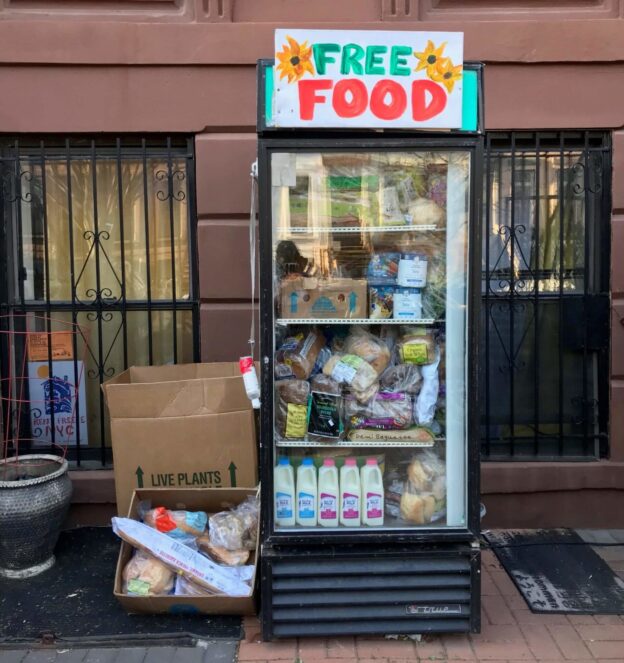
Photograph of a community fridge full o ffresh food. On top of the fridge, a sign recites "Free Food" in colorful letters

Revised Project Proposal – NYC Community Fridges Archive

Team Members and roles

  • Elena: Project Manager, Social Media, Omeka Developer
  • Allison: Community Outreach Coordinator, Omeka Developer
  • Jean: Research (esp. found images), Writer/Word-Editor
  • Lola: Research, Omeka Developer
  • Montage: Research, Omeka Developer

Abstract

Our project NYC Community Fridges Archive will create an archive that preserves the histories around local community fridges installed in New York City facing food insecurity during the COVID-19 crisis. Though, back in February 2020, an anarchist community A New World in Our Hearts initiated the use of a community fridge to share the city’s extra food with those in need, multiple local communities, after that model, have implemented their own fridges (amounting to 75 in the New York metropolitan area as of November 2020) to provide fresh, free food to their communities amidst the pandemic-inflicted food scarcity. Beyond food, these fridges have been providing places for locals to come together and heal through literary and artistic activities in enduring communities they have organized. We see this community-based practice around NYC community fridges as a new form of activism arising in the city and our digital archive thus strives to collect and represent visual, oral, and otherwise textual histories of that resistance. Our project is first and foremost to assist precarious local communities in preserving their histories, to create a playbook for building community around food security. To do so, our archive will emphasize relationships between people that form a collaborative structure of a digital humanities project. With that goal, we will use the open-source platform Omeka which can display an interactive map to each fridge’s information. Our website will serve both as an archive and an ongoing platform to further support solidarities and memories surrounding NYC community fridges.

Environmental Scan

The Community Fridge Archive aims to become a comprehensive historical record of solidarity fridges, as an example of community mutual-aid initiatives during the pandemic. This public archive will provide primary sources to future academics and the public about the communal response to the pandemic, food security, infrastructure and any themes that historical distance inspires. The oral histories will highlight the voices of the community that has built around community fridges, providing a space where participants can share their perspective directly as an antidote to media narratives which have focused narrowly on the role of the anarchist collective. This project also aims to promote the community fridges as an additional public and easily accessible source of information for the community.

Community fridges continue to grow in number and attract more attention, but there are no public efforts (in NYC) to build an archive or oral history project similar to the Community Fridge Archive. While our search for projects similar or related to the Community Fridge Archive will continue, there are no plans for discovery in the next week. The following projects inspired the creation of the Community Fridge Archive in their attention for local communities, activist stance, and focus on care.

A People’s Archive of Police Violence in Cleveland

This digital archive collects and shares accounts of police brutality as they are experienced by citizens of Cleveland, Ohio. It was organized in 2015 in response to the “pandemic level” police violence, to collect community testimony of these events and counter the police narrative that allows officers to escape accountability.

Preserve the Baltimore Uprising: Your Stories. Your Pictures. Your Stuff. Your History

Started in April 2015, Preserve the Baltimore Uprising is a repository of digital material about the civil response to police brutality in Baltimore after the death of Freddie Gray. The project has extended to include testimony of protests against police brutality, vigilantism, and racial injustice and inequality in Baltimore.

Queer Newark Oral History Project

The Queer Newark Oral History Project is a community-based and community-directed initiative and supported by Rutgers University-Newark. Founded in 2011 by Darnell Moore, Queer Newark preserves the histories of LGBTQ people and communities. The local community can get involved by volunteering to conduct interviews, transcription, website development, and design.

Technologies

Omeka Classic will be used to build, store, and manage content; HTML/CSS to build a website; Instagram, Twitter, and Facebook for public outreach; Trello, Zoom, Slack, and Google Drive for team work/collaboration. Our team members are proficient in HTML/CSS, Instagram, Twitter, Facebook, Trello, Zoom, Slack, and Google Drive. The team members responsible for Omeka will be completing tutorials and workshops to gain proficiency.

Group Management

  • Email: for updates and communications
  • Zoom: for weekly meetings (Thursdays at 5pm)
  • Trello: the team will report to the project manager on Trello by posting on their progress, asking questions, and/or making comments.
  • Slack: for fast, everyday communication
  • Google Drive: for keeping our forms and materials as well as for recording the summaries of the meetings for our future reference.
  • Phone: as last resort if someone disappears or is unresponsive.

Project Proposal: Mapping Cemeteries in Manhattan: 1820-2020

I know it’s after the two deadlines we agreed on, and my apologies, but if possible (after much wavering), I’d like to put my mapping project up for discussion.

Overview

Death is an inescapable and universal part of being human, but the rituals and care provided by the living to their dead are shaped by many changing factors, including emotional, physical, financial, societal, and spiritual/religious. Cemeteries are one type of designated space created by the living for the care of the dead. Archeologist Elizabeth Meade says, “Because of this responsibility, burial grounds can serve as significant cultural spaces utilized by and integral to the cultural traditions of the living. For the living, cemeteries encapsulate both the physical aspects of death and utilitarian nature of decay as well as the cultural influences that govern death ritual and the social transition from life to death” (Meade 2020). There’s also an inherent tension between remembering and forgetting that happens in cemeteries, with human memory and grave markers both subject to erosion. Within a city like New York, especially on the island of Manhattan, a large population confined by a definite geographical area adds to this tension. A population of this size necessarily requires the care of a larger number of dead, and it also means that the physical space allotted for the dead competes with the space allotted for the varied activities of the living.

This project aims to create a story map to visualize cemetery obliteration in Manhattan between 1820 and 2020. In addition to the nice numerical symmetry provided by these two years as end points, the population of New York City (then still just Manhattan) more than doubled between the 1800 and 1820 Census, and 1820 also narrowly precedes the burial restrictions implemented in 1823. 2020 will also still be a very recent past when this project is being built, and it is a year very much influenced (if not defined) by the global coronavirus disease (COVID-19) pandemic. As much of the legislature regarding cemeteries in New York in the 19th century was written and passed in response to outbreaks of yellow fever and cholera, it will be illuminating to investigate their effects at a time when the full impact of the COVID-19 pandemic is still being examined and understood in the present.

The base layer of the map will show the existing cemeteries in Manhattan as of 1820, overlaid on a historical map of Manhattan available from the NYPL using their free Map Warper tool (perhaps this one), including their specific sizes and locations. Informational pop-ups will also include the year each cemetery first came into use, the type of cemetery it is or was (such as commercial, religious, public, or familial), and overall demographic information about the people who were buried there. For the cemeteries that no longer exist as such, the map will indicate what project originally replaced it, either partially or completely (e.g., infrastructure such as roads and subway lines, parks, or buildings). There will also be images of what the area looked like in 2020, as well as median household income and demographic information for the Census tract in that year.

Intended Audiences

The intended audiences for this project are scholars and the general public interested in the following:

  • cemetery studies
  • urban planning
  • local history
  • historical maps and mapping generally

Contribution to Digital Humanities

This map will help humanities scholars, cemetery studies scholars, local historians, and all interested New Yorkers explore questions related to urban planning and sustainability and also questions about belonging, community building, and how power structures determine who “deserves” to be remembered and the impact these have on living populations. Complementing the above data, the story portion of the project seeks to explore the considerations that went into repurposing the land from cemeteries to other uses. How were these proposals first brought forward, and by who? City design is a type of infrastructure, and the decisions on how to build it and how to alter it are necessarily political (Star 1999). As much as infrastructures are built to be of service to people, they also impose limitations on how we interact with and experience them (Gil 2016). How people live and die in the city affects and—perhaps more so—is affected by its landscape.

This project also seeks to find trends regarding the cemeteries that were preserved and the ones that were obliterated. For instance, several prominent parks in the city—Washington Square, Madison Square, and Bryant Park—were sites for potter’s fields where the unidentified, poor, and those of all classes who died of yellow fever were buried (French 2020). How does this trend reflect both historical and current power structures, and what are the implications for the surrounding neighborhoods? Even if a public park could be argued to enrich the public at large, its creation likely also substantially increased the private wealth of those who bought and developed the land around it. So what ultimately is the public good—how is it defined and by whom? This map will help users explore these land use transitions and the relationships between private and public spaces further. In addition, there are repurposed cemeteries where the bodies have not been moved and the sites remain unmarked. What does this collective forgetting—in some cases purposeful—of a cemetery mean for living descendants, and how do cemeteries contribute to our understanding and claims of belonging to certain communities and specific locations?

Environmental Scan

There is much interest in cemetery studies as it relates to personal genealogies and family histories. This mapping project will view cemeteries on a larger scale and view them in relation to and as part of the urban landscape in New York City.

The New York City Cemetery Project, created by anthropologist and museums and archives specialist Mary French, comprises archival research and a narrative snapshot for each cemetery, accompanied by historical images, newspaper clips, and snippets of maps, for approximately 350 cemeteries in the city dating from the colonial period onward. It is a tremendous project offering a wealth of knowledge on the cemeteries she has researched; however, the blog-like presentation of the information doesn’t easily allow for examination of the cemeteries in comparison with one another or an understanding of the physical spaces they occupy or occupied.

In her anthropology PhD dissertation for The Graduate Center, City University of New York, Elizabeth Meade sets about providing the most complete record of historical cemeteries in the five boroughs. She admits that her study is incomplete as it includes only cemeteries that were intentionally built and recognized as such. It is also based on the historical records available from the colonial period onward, and so excludes the burial activities of the indigenous people pre-contact. Furthermore, as record-keeping and preservation are timely and not without significant costs, much of the available records likely skew toward cemeteries and groups of European descent with means.

Acknowledging these limitations with the utmost sensitivity, this project will build most of the data pertaining to cemeteries in 1820 from Meade’s dissertation. Her dissertation presents the maps in segments (as a limitation of the size of the page), but she also has built a website with the full map. The story map proposed herein will work to combine narrative and map into one cohesive experience. It will also aim to compare the historical demographic data with more current demographic data to help better understand how communities have changed. The story map proposed here will focus on the absence of certain cemeteries in 2020 because those absences are full of meaning that needs to be identified.

This project is the first phase of a further exploration of the ties between cemeteries and other outdoor spaces in the city.

Final Product and Dissemination

The final product will be a interactive and multilayered map that compares the status of these historical cemeteries between 1820 and 2020, along with historical and more recent images, and comprehensive text providing background on legislature and trends affecting the landscape of the city.

Project participants will share links to the final project via their various social media streams, namely, Twitter, Instagram, and Facebook. They will reach out to those in charge of the social media accounts within The Graduate Center community to share our posts, including professors within the MA in Digital Humanities and MS in Data Visualization programs, the CUNY GC Digital Initiatives team, and GC Digital Fellows team.

Pertaining to New York City history, they will also reach out to local media outlets such as Gothamist, New York Daily News, and WNYC to provide coverage of our project, or at least share the social media posts to a wider audience. Given their special interest in creating maps and previous coverage on cemeteries, the project lead will write up a post summarizing the mapping project to share with Atlas Obscura for them to share on their site and via their social media channels. The project lead will also share write-ups with the websites Untapped New York and 6sqft as they have also previously posted content about New York City cemeteries.

Skillsets Needed

Much of this data already exists as part of Elizabeth Meade’s recent PhD dissertation in Anthropology at The Graduate Center. I will reach out to her about sharing her data.

I would also like to consult with and interview an urban planner (I know someone, though he is based on Long Island) and local historians familiar with the time period.

I believe a large portion of time will be spend collecting demographic and financial information for the relevant Census tracts, and then cleaning that data along with Meade’s data from her dissertation.

There will also be a significant amount of time spent writing and editing the accompanying text.

My experience with mapping tools and data analysis is very limited, so this project will greatly benefit from someone more knowledgable in these areas.

Someone more familiar with social media strategies would also be a great asset in the dissemination of the final product.

Concerns

In my proposal from last semester, I admit I struggled to define roles for the participants as many of the technical skills I’m relying on are mostly unfamiliar to me. I’m also not happy that my original proposal relied on the use of propriety software: ArcGIS StoryMap, but in my limited experience it is the program I’m most excited about as it beautifully integrates text with the map. I do not wish to pay for it, nor do I have funding for it, and I would greatly prefer being able to use an open-access platform instead. Currently this proposal isn’t very clear on what type of demographic data will be included–would it be based on Census data (how have the categories changed and is even possible to compare 1820 and 2020 data if the categories aren’t the same?). I’m also concerned that the inclusion of 2020 financial data may be tricky to include. A lot of information is based on zip codes, which are not the same as Census tracks, and there can exist much unequal distribution of wealth within very small areas (and definitely within zip codes).

Your feedback on these areas would be greatly appreciated–if we work on this project for class or I eventually pursue it in a not-so-distant future.
Project Proposal: Reading Rebus Writing

Abstract

The ubiquity of emojis in our digital chat conversations invites interrogation into rebus writing as a predecessor to the emoji and an interdisciplinary area of study, intersecting many aspects of digital humanities. By definition, an emoji is a pictogram representing an object; an ideogram representing an abstract concept; or an emoticon representing human emotion. Pre-dating emojis, a rebus is a symbol representing a sound, syllable, part of a word or whole word, regardless of its meaning. Rebus writing combines visual elements with letters, words and phonics to create puzzles which need to be deciphered and translated in order to understand their meaning. Coinciding with France’s invasion of Egypt and subsequent discovery of the Rosetta Stone in 1799, rebus writing became a form of playful expression in late 18th–early 19th century Europe and America. Used in printed broadsides, advertisements, letters, reading exercises, bibles, picture puzzles, and newspaper games, rebus writing became distinct from its ancient origins and entered the daily lives of children and adults as visual vernacular.

Reading Rebus Writing (RRW) is an online, visual archive of late 18th–early 19th century European and American rebus ephemera, along with research into their history and cultural uses. The project aims to make a select group of historical rebus ephemera accessible in an engaging, collaborative and interactive format to scholars in diverse fields such as linguistics, history, education, communications, design studies, and visual arts, as well as members of the general public – opening up new possibilities for discovering how we see and interpret visual information. Each rebus puzzle will be treated as an interface of inquiry to conduct close reading experimentations, translations and ambiguous interpretations by audience participants. RRW challenges the notion of traditional texts by using humanistic qualitative analysis, while also contributing to the history of language, visual literacy and visual communication, connecting cuneiform and hieroglyphs to contemporary, digital emojis. 

19th century Rebus Valentine Letter.

Left: 19th century Rebus Valentine Letter. John Johnson Collection, Bodleian Library, Oxford University.
Right: Detail with my interpretation. Does the meaning of the content change if the observer interprets the pictograms differently?

Enhancing the Humanities through Innovation

As a digital archive developed with WordPress, RRW will use existing digital repositories and institutional library holdings (example one, two, three) to curate a small selection of British and American rebus writing ephemera published in the late 18th–early 19th century for interpretation, translation, discourse and experimentation. The goal is not to gather every example but to provide a digital playground for close reading experimentations and translations. Each rebus will be treated as an interface, a point where visual systems, typographic systems and interpretation meet. As one hovers a mouse over areas of the rebus, translated English words will appear, aiding in the interpretation of the content. If there are multiple interpretations, all possible words will appear. Since interpretations are based on humanistic analysis of the visual, a participant will be prompted to submit their interpretation, offer their point of view, leading to alternate meanings. There may also be instances where a pictogram cannot be identified by the project team, so audience submission will be encouraged.

Additionally, essays on the history of the rebus, cultural impact and its placement between the origin of writing and current-day smartphone emojis will be provided for context. 

  • Can a visual vernacular be established for people of late 18th–early 19th century Europe or America and if so, what is its cultural significance? 
  • Does the appropriation of minority cultures by a dominant group impact the reading of the rebuses or their subject matter? And how does this cultural, visual appropriation affect the history and development of language and communication?
  • What conclusions about late 18th–early 19th century European and American society can be drawn from the way rebuses were drawn and where/how they were printed?
  • Can rebus writing, with its use of visual symbols and ambiguous interpretations, be considered a “text”? [“What makes a text a text—its susceptibility to varying levels of address—is a feature of book culture and the flexibility of the textual imagination” (Witmore)]

Environment Scan

RRW differs from a typical digital archive due to its reliance on the integration between the visual and textual qualities of the rebus artifacts – a visual symbol and its reading exist in a symbiotic relationship. Here are a few projects that share similar theoretical and physical, interactive characteristics:

  • The Global Medieval Sourcebook at Stanford University – for each artifact, a participant can see a parallel panel view for English language translations, side-by-side, line-by-line.  
  • The First Six Books of the Elements of Euclid – Presents the text, in a format similar to the printed publication, with shapes that highlight areas of an accompanying diagram when clicked on.
  • Fabricus by Google Arts & Culture – Related to this field of inquiry, however, RRW is not interested in employing sophisticated machine-learning technology which may have biases present in their algorithms. Instead, the project will emphasize the “human” aspect of the digital humanities. While this method may yield inaccurate or inconsistent results, it is important to recognize that different users may interpret rebus writing in different ways. The variation of rebus puzzle solutions may reveal alternative ways users see visual symbols and make them aware of their own knowledge production as observer co-dependent and interpretative, actively constructed from the user’s observation and experience (Drucker). 

Audiences

The first iteration of RRW will be disseminated through various channels related to the different audiences. The project team will reach out to departments at universities (linguistics, art history, communications, art and design, history, etc.) to attract academics and students who may be interested in the project for research or teaching. 

To reach public general audiences, as well as some scholars, information about the project, along with images of the rebus ephemera will be posted on social media networks, along with a call to action to help us solve the puzzles by submitting translations. Project team members may also have access to mailing lists within their specialties. 

Efforts will be made during the design and development phase to ensure the content is accessible, such as descriptive alt-text labels.

Team / Skills

For the first iteration of the WordPress website (completed this semester) team members will establish criteria for the curation of rebus examples, decide how many are shown, offer interpretations, design and develop the website, perform outreach to audiences and write essays for context.

  • Design and Development/UX
  • Research / Writing / Puzzle-Solvers!
  • Social Media Outreach
  • Project Management
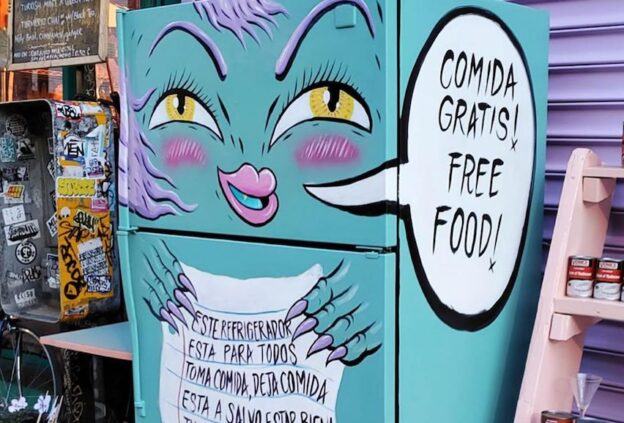
Photo of a community fridge. The fridge is painted light blue and decorated to look like a smiling monster. A balloon from the mouth of the monster recites "Comida gratis! Free Food!"

Project Proposal: NYC Community Fridges Archive

Abstract

According to the Food Bank for New York City, an estimated 1.4 million New York City residents rely on emergency food programs, including soup kitchens and food pantries, each year (“Research, Reports and Financials”). When COVID-19 hit New York City in March 2020, the situation grew even worse. New York City food pantries had to declare a state of emergency in April (Biron). Just before the outbreak of COVID-19 in February 2020, the anarchist community A New World in Our Hearts set up a community fridge to help distribute the extra food from their weekly grocery pop up Food Not Bombs. When the pandemic hit, local communities started asking A New World in Our Hearts for information on how to set up their own community fridges (Carter). As of November 2020, there are 75 throughout the New York Metropolitan area, providing fresh, free food to their local communities. Many fridges have been decorated by local artists and have become pieces of public art around which the community meets, organizes, and heals.

These fridges are a great example of the city coming together during tough times and creating something new, subversive, artistic, and helpful. They represent a new form of community activism in the life of the city and, as such, their memory needs to be preserved and made available to the public. I intend to create the NYC Community Fridges Archive, a community-based digital archive that collects photos, video, text, oral histories, and media content about the community fridges.

The aim of the project is to assist the local communities in preserving their history, to create a playbook for building community around food security. To do so, the NYC Community Fridges Archive will give a central role to the set of relationships between people that form the structure and support for a digital humanities project. The NYC Community Fridges Archive will use the open-source platform Omeka to display an interactive map with basic information about each fridge, a link to a page with a detailed description of the fridge, photographs, oral histories, and more. This website will serve both as an archive and an ongoing platform to collect information about community fridges.

The project exemplifies Sheila A. Brennan’s concept of Public Digital Humanities, where public history and the humanities “place communities, or other public audiences, at their core” (Brennan). The NYC Community Fridges Archive embodies Kathleen Fitzpatrick’s idea of “generous thinking” (Fitzpatrick) [by serving the local community in a historical moment of crisis and resistance.

Final Product and Question/Problem it helps answer

The phenomenon of the community fridges is not only having a concrete impact on the lives of many New Yorkers, but also constitutes a roadmap of how to mobilize a community around food sovereignty. To do so, the multi-faceted memory of this unique experience needs to be preserved and shared. The decentralized nature of this mobilization constitutes a challenge in archiving the memories of the communities they serve: each fridge has its own coordinators, social media page, and initiatives. A New World in Our Hearts gives visibility to the community fridges and their initiatives through their Instagram page @iohnyc, but they are focused on concrete, immediate action – archiving simply goes beyond their scope.

The goal of the NYC Community Fridges Archive is to serve the community by creating a user-friendly repository to collect text, photographs, videos, and oral histories about the community fridges of the New York Metropolitan Area. To do so, the archive will be built with the open-source platform Omeka. It will feature a page for each fridge with detailed information, links to social media, and multimedia content submitted by the users. If the community expresses the need for preserving social media posts, our team will install a plugin to aggregate social media content related to the community fridges.

Intended Audiences

1. Local communities that revolve around the fridges

My first intended audience is the community that revolves around the fridges: this includes the people that use the fridges; the organizers, activists, and volunteers that stock and maintain them; and the restaurants and business owners that donate food. The NYC Community Fridges Archive would not only be a way to showcase their community building work and preserve their memories, but it would also represent a platform to share advice and best practices on how to set up, manage, and stock the fridges. The strength of this audience is that the community is already there, it just needs to be involved in creating the archive. Another advantage is that most people have smartphones and use social media, especially when interacting with the Instagram pages of the community fridges: this will make it easier to reach out to them. One important limitation to consider is that not all of the people who use and maintain community fridges have a stable internet connection or a laptop at home. To create accessibility, the archive will need to be built as a lightweight structure that can be accessed from smartphones and with a low connection. Another challenge is that, for many users, English is a second or third language: my idea is to allow contributions in any language, and possibly creating a version of the archive in Spanish for a future implementation.

2. Local nonprofit organizations

The second target audience is the ecosystem of local nonprofit organizations in New York City. Nonprofits would benefit from a comprehensive map of community fridges, so that they could share the information with people in need and point them out to resources in their neighborhood. The advantage of this audience is that they already have a mission to help people; this, combines with the fact that nonprofits already have a community they serve, makes them the right partners to promote the NYC Community Fridge Archive.

3. NYC Population at large

After involving the fridges community and the nonprofit world, my goal is to share the archive with the NYC population at large. The NYC Community Fridge Archive would serve as a repository of an important historical moment in NYC history, and it could help other people start their own mutual aid initiatives in their neighborhood. Moreover, the archive could be used by teachers and educators to teach about local history and involve students in contributing to the repository and conduct oral history projects.

Contribution to DH and intended impact

Local communities will not only be the beneficiary of the archive, but they will constitute its backbone: the project will start with establishing relationships on which to build the crowdsourcing efforts. To do so, the NYC Community Fridges Archive will follow the tradition of the Digital Public Humanities, a branch of Digital Humanities that lies at the intersection of public work, digital work, and humanities work. Digital Public Humanities consider the human component before the technological, and reject hierarchies between academia and the public, teachers and students, senior and junior scholars (Stommel). As Susan Brennan states in Public First, “Doing any type of public digital humanities work requires an intentional decision from the beginning of the project that identifies, invites in, and addresses audience needs in the design, as well as the approach and content, long before the outreach for a finished project begins” (Brennan).

This project was also inspired by Kathleen Fitzpatrick’s notion of Generous Thinking. Fitzpatrick invites us to broaden our sense of the spaces in which scholarly thought can take place and engage the public in the conversation instead of including it only as an afterthought. This is not only beneficial for the public, but it’s what is going to make scholarly work relevant and useful for the community around it(Fitzpatrick).

Skills/Software Needed

  1. Omeka: I’ve never used it yet, but there is a great tutorial on the GC Digital Fellows website by Stefano Morello!
  2. Omeka plugins (for maps and eventually social media)
  3. QGIS for map (if we don’t like the Omeka plugin)
  4. Research skills
  5. Social Media skills
  6. Relational/community building skills
  7. Public speaking (on Zoom)
  8. Writing

Legal and technical barriers and how to meet them

Challenges:

  1. Working with the public introduces an element of chaos and unpredictability
    • Will people get on board? How many?
    • Will people use the archive?
  2. Privacy issues:
    • How to protect people’s privacy and identity?
  3. Accessibility:
    • Technological: Not everybody owns a smartphone/PC/tablet
    • Connectivity: not everybody has a stable internet connection at home
    • Linguistic: many people do not speak English as a first language
    • Disability: many people, especially older folks, have visual/hearing/mobility impairments

Possible solutions:

  1. Embrace the mess, but with a plan: working with the public is inherently going to be a little chaotic, but I believe it’s a great learning experience for the future. In order to learn about what the community needs, but maintain a structure, we will:
    • Contact Community Organizers (people who are in charge of a fridge) with a set of questions we prepare in advance
    • Town Hall meeting on Zoom, with a brief presentation and a moment for Q&A
    • Social Media for feedback and to gather attention
    • Moderators for the Archives
    • tutorials to explain how to contribute to the archive
  2. We will prepare a page with Contribution Terms of Service and Usage Terms/Third-Party Use with input from the community. Other digital community archives have it and I think it’s a great idea to protect everybody
  3. Accessibility:
    • The archive will ideally be mobile-friendly and accessible for people with visual impairments. These characteristics are supported by Omeka
    • Mobile-friendliness will include a “light” website that can be supported by a smartphone with low broadband
    • User-friendliness will be considered at every step of the process. For example, how easy is it to submit materials to the archive? Is the language clear and explanatory?
    • (Ideally) the archive will have a Spanish version at some point

Work Plan (Tentative)

  1. Create/Acquire a list of Community Fridges with locations, contact information, and Instagram Handles
  2. Contact Community Organizers
  3. Town Hall: presentation about project to mobilize community and collect input on their needs (Zoom Call)
  4. Build Omeka Structure
  5. Create map of fridges on homepage and a page for each fridge
  6. Create Social Media profiles for the NYC Community Fridges Archive (Instagram, Facebook, Twitter)
  7. Write Contribution Terms of Service and Usage Terms/Third-Party Use with input from the community
  8. Make video tutorial to show how to make contributions to the archive
  9. Email/Social Media blast to incite contributions (with link to video tutorial)
  10. Moderating contributions and help desk
  11. Launch Party (on Zoom)
  12. Project dissemination
  13. (Optional) Plug-in application to aggregate social media

Guiding principles

My guiding principles for the NYC Community Fridges Archive will be of ethical rather than technological nature. My first goal is to be rooted in a practice of care, where the community and the team work together in mutual trust and respect. This requires transparency on both sides, every step of the way: a community-based archive needs to communicate clearly and honestly with the community it serves. Finally, the project will also address accessibility not only for people with disabilities, but also for non-Native English speakers and those who do not have access to personal computers and broadband.

For more information and the bibliography, read the entire proposal here (in our Group Library)!

Freedom of Speech* || Draft Project Proposal

Congress shall make no law respecting an establishment of religion, or prohibiting the free exercise thereof; or abridging the freedom of speech, or of the press; or the right of the people peaceably to assemble, and to petition the Government for a redress of grievances.

Overview

Freedom of Speech* is a web project that helps users to understand the First Amendment right to freedom of speech through interactive visualizations of Supreme Court verdicts that have expanded or contracted the definition of “free speech” over the history of the United States. Users can change parameters including the act of speech, date, court make-up, race of the defendant, and/or status of peace/war to see how the protection of free speech may change. For example, a user can set the filters to see if speech that is considered violent would be protected in 1969, and compare that same speech to its protection status in 2010. Users can also explore a timeline of landmark free speech decisions to view U.S. history and historical events through the changing lens of free speech protection.

Main Questions & Context

    • “What is the US’s stance on limiting freedom of speech/expression?”
    • “What does ‘freedom of speech’ really mean?”
    • “How has the right to ‘freedom of speech’ changed over time?”

This project aims to dispel misconceptions about the First Amendment (specifically its blanket protection of freedom of speech) as static and limitless, and to illustrate how historical circumstances, diplomatic relationships, or the realities of race, class, religion, and other aspects affect whether and how free speech has been protected by the U.S. government.

Intended Audience

Our intended audience is a layperson—one with an interest in the First Amendment that might have been sparked by, say, our last president being banned from Twitter. Is that legal?? (Yes.)

We have both seen many, many instances of people misunderstanding “First Amendment Rights” (in fact, arguing exactly the opposite) in the last few weeks/months/years. We’d like for this project to be an accessible way for the average person, i.e. one who doesn’t speak legalese, to understand 1. who/what is and isn’t covered by First Amendment FOS protections and 2. that freedom of speech protection is not static and clear cut, but an evolving category with sometimes-surprising verdicts.

Contribution to Digital Humanities & Potential Impact

With the massive rise of apps like Parler, discussions of safe spaces and snowflakes and censorship (oh my), and the continuing challenges of “cancel culture,” free speech is a hot topic these days. As the U.S. comes to terms with what free speech means in the internet age, a baseline literacy and understanding of the concept as it is written in the Bill of Rights becomes more and more important.

This Digital Humanities project contributes to the field through its goal of improving critical thinking skills, and fostering a better-informed civic populace, around a topic that is today largely synonymous with social media. We understand that humanistic concerns like good design and aesthetic choices make all the difference to whether someone engages with the topic or not—particularly when it’s one that we hope they will encounter on Twitter or Instagram—and hope to make a robust, data-driven app that is also a pleasure to use and look at.

Final Product

Our goal, from a UX/UI perspective, is an accessible, friendly, non-patronizing website that encourages critical thought while remaining mindful of cognitive overload. We will focus our design on simplicity, performance, and user-friendly architecture, particularly targeting mobile-first design, given that we expect the majority of users to access our site via social media.

We will leverage data visualization with user-adjustable parameters to make a large, unwieldy topic more accessible and relevant to a single user. This is a tried and true strategy utilized by publications like The Upshot and The Pudding, and helps both to hook users in and to help them empathize with questions much larger than one person.

Feasibility Assessment

This project can be completed within a semester. It will require a project manager and an outreach director. Any more help in research, development, and design would be welcome, though these are the areas we have best covered already.

This is an ambitious technical undertaking, but Joanne and Eva are well-positioned to adjust to that. If another developer joins our team, we can do more research and design, and if more researchers or designers join, we can do more development and less research/design. The technical toolset envisioned for this project is a combination of R/Python for data wrangling, Parcel.js or Vue.js or React.js for backend development, and HTML/CSS, d3.js, P5, and vanilla Javascript for frontend development. That being said, we are open to other tools and expertise.

The major tasks will be wrangling and cleaning data, codifying certain necessary variables, and performing text analysis to turn court verdicts and dissents into searchable categories. Currently, the data looks something like this. To complete this project, we will need to do research on the legal history of speech as an issue before the Supreme Court, including the divisions between commercial/political speech and what cases were subject to which landmark case tests.

Skillset Needs

Project Manager: Needed

Outreach: Needed

Research: Lots already done, lots needed for data cleaning/analysis/quality

Development: We are strong here but more help always welcome

Design: We are capable enough here but certainly welcome more experience


This proposal was assembled by Joanne Ramadani and Eva Sibinga.