Lisa’s Public Journal – Week Eleven — Fun with Images

Fun with Images

I have been moving between research that is reading and research that is visual. I’ve found several images of the Worth Memorial location which show the site in such a way that you can compare that historical reference to its current state. This is fascinating to me because it so clearly shows how the city has changed.

When the memorial was originally constructed, it dominated the landscape. This can be seen clearly in the lithograph below, which shows its 1857 dedication ceremony. Any buildings are far away, as the intersections between Broadway and Fifth Avenue merged at its base and the cobbled stone roadways were wide and deep, with Madison Park seemingly far in the distance.
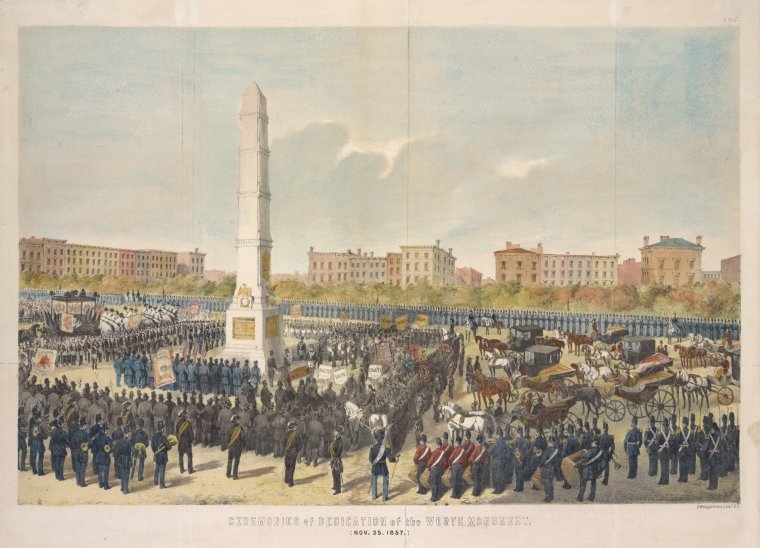
The Miriam and Ira D. Wallach Division of Art, Prints and Photographs: Print Collection, The New York Public Library.

Ceremonies of the dedication of the Worth Monument. (Nov. 25, 1857), from The New York Public Library.

Some thirty years later, not much had changed. The area is still dominated by wide cobblestone streets, but now there are the metal tracks for the trolly lines, electric lines for arc lighting, and a posh hotel, build across from the monument itself.
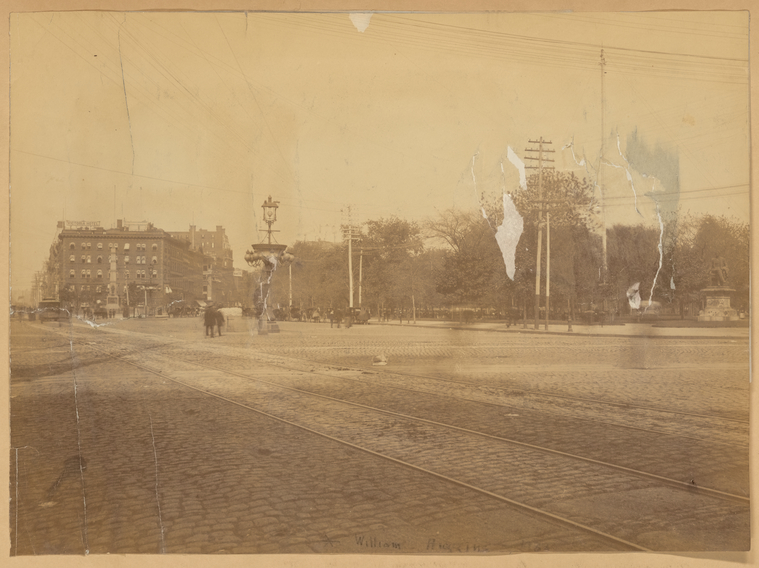
Irma and Paul Milstein Division of United States History, Local History and Genealogy, The New York Public Library.

Madison Square: Edison Electric Arc Light, Worth Memorial, William Seward statue, Hotel Victoria. Circa 1884. From The New York Public Library/

However, by 1930 (the likely date of the stereograph below) Broadway had been narrowed and buildings constructed, hemming the monument in.
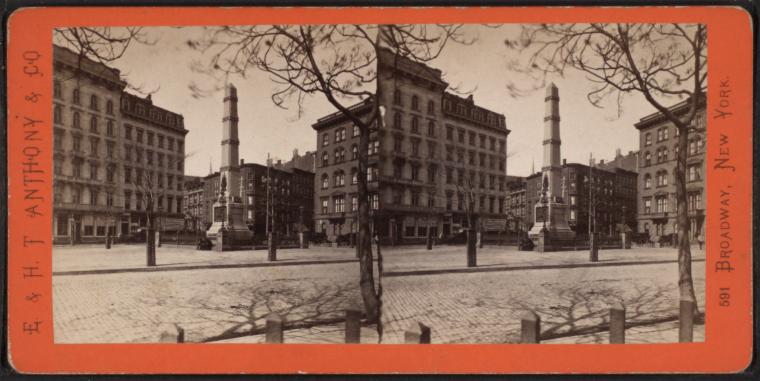
The Miriam and Ira D. Wallach Division of Art, Prints and Photographs: Photography Collection, The New York Public Library.

Worth Monument, South Front view. Circa 1930. From The New York Public Library.

Over time, the buildings have only grown in height until they dwarf Worth’s resting place. In the comparison below, you can see the 1930 view and the 2021 view, side-by-side, at almost the same angle. Without the sky, the monument is absorbed by the streetscape.
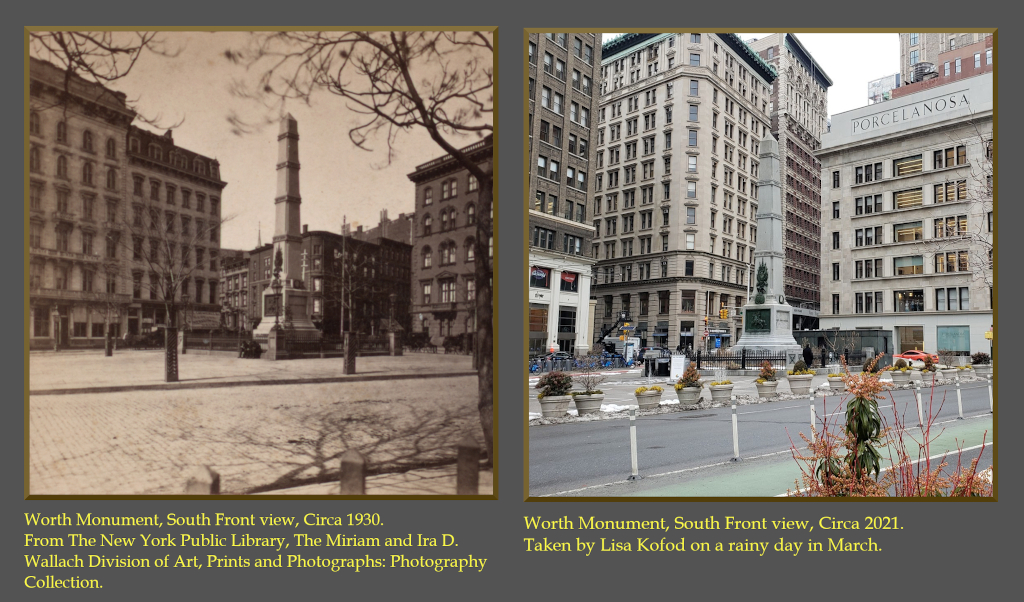
Comparison Photo Composite of Worth Square circa 1930 and circa 2021.

Worth Square as seen in 1850 and in 2021. The 1850 image comes from the New York Public Library’s digital collection.

These images are metaphors for the man’s memory. At his death, his memorial dominated the scene. But now, subsumed by the street-scape, it disappears from our view. And yet, it is still there if you have a mind to see it.

[A note for Bret: No matter what I do, I cannot get my photos to render properly.  Something about this theme changes their aspect ratio.  Can you correct this?]
Getting to the most fun part

During the past two weeks, our team has achieved a big part of the functionality we hoped to get to with our timeline. The vertical and horizontal timelines are now interactively dependent, which is really nice to see, since we have only been talking about how we imagine it to be since the beginning. I have also created one of the individual cemetery pages as a way to show the team for our upcoming meeting and discuss layout and data presentation on the pages.

One thing I am looking forward to is our branding meeting which will be this week. We are finally getting to the fun part!!! Choosing color schemes, fonts, icons, a logo will reinforce our vision and make it come to life by applying to the website.

Other than working on the website development this week, I finally got to do some research on the New York Marble Cemetery. The cemetery is actually becoming a common place to organize weddings. It has also put its last two vaults  (supposedly the last two burial plots in Manhattan) for sale, each for 350,000$ in 2015. How crazy is that!!?? Clearly, this research is turning to be fascinating. It has been really cool to look at the history and progression of the two marble cemeteries, although my focus will be on the New York Marble Cemetery, not the New York City Marble Cemetery.

Finally, I wanted to express how happy I am about the ways which our team has found to document the process. I believe that the WordPress commons website works hand in hand with the project website hosted on Github to show process and product in harmony.

Decisions and Documentation

As mentioned in the group update on Friday, we finally made some big decisions and improvements to the site this week. Thanks to the hard work of the team and consulting with our student advisors, the prototype is starting to really come together. On Thursday we’re hoping to decide on our logo.

Over the weekend I’ve been working on putting together some documentation of the workflow and submission intake processes for the team to follow. The documentation isn’t the fun and glamorous side of the project, but it’s critical that we all have the same reference points to follow. A lot of the work that goes into our project is about careful intake and version control before submissions are posted to our online gallery. We need tight organization and naming conventions. The team was feeling some pain points over the past couple weeks by not having documented guidelines, so I’m hoping to improve that. Additionally, we’re all trying to make the project handoff as smooth as possible for its next phase after this semester and this work will help make that possible.

Another piece the group needs to work through is our social media plan. On Sunday we talked about how our collaboration with students and educators through the team’s networks makes up the majority of our outreach plan. While we initially thought Instagram and FB accounts might help us with submission recruitment, we’re brainstorming new ways for how to best use those spaces. In order to take better care of our student contributors, we need to keep our group small for now. We’re thinking of showcasing select submissions through Instagram so that students can be proud of their work and easily share with their friends. But we’re also unique in that the content isn’t completely ours to share. We need to be respectful of the privacy of the students and whether they would want personal submissions to be shared out to social media.

I’m really inspired by all of the thoughtful conversations the team has had over the past few weeks. We’re making great progress and learning so much as we go.

Elena’s Journal – Week 11

It’s official – I’m exhausted!

Working on a passion project means giving it your all, and I’m now realizing that that’s not always the healthiest place to be. Part of my job this week will be trying to step back and not micromanage, and finding time to rest.

But now, I don’t want to be a Debby Downer. I’m the self-proclaimed Queen of Silver Linings for a reason. Let’s list some good news!

  1. As I announced in our Group project update, we have an archive! It does not look fancy, but it has solid foundations. We are almost done entering all our fridges and collections, and we have officially opened our contributions campaign. Yay!

    If you get this GIF, you are automatically my friend.

  2. Great news I learned today: 3 people signed up to be interviewed for the NYCCFA Oral History Project! That’s for my other class, Digital Memories, with Prof. Borrachero. I’m taking the “reuse and repair” motto of DH seriously. This means that soon we’ll have oral history interviews (transcribed and then indexed with OHMS) in our Omeka archive! Double Yay!

    Same as above for the GIF

  3. The Archive is doing great on Social Media and IRL! We are receiving good responses to our social media posts on Instagram, and my mom has been liking all of our Facebook posts – it counts, right??? No joke though, invite all your friends and family to follow us on social and spread the word about our contributions campaign.

Sorry for all the silly GIFs, but it’s my way of processing all these great things happening. See you all on Thursday!

lane journal entry – progress on outreach plan & project research

This past week has been productive and quite eventful. I took on the task of creating visual images of each team member’s definition of Mapping Cemeteries, which will be included on our Making Mapping Cemeteries site, social media, and potentially our final website. I had a lot of fun finding images, toying around with different visual effects, colors, and fonts (our group, particularly Asma can really appreciate a good font). I created similar visual images which include definitions of necropolitics and deathscapes — two key topics in our project that may be new to our audience.  

Our first social media posts have gone up on our Instagram and Facebook pages! While it may seem trivial, it was both exciting and gratifying to receive some positive feedback on the posts. Asma and I have been brainstorming our Outreach Plan for the past few weeks, meeting outside of class via Facetime or chatting over text. It’s been such a fun experience for myriad reasons, one being that Asma is an outstanding person to work with!  

The first post included the previously mentioned images of our team definitions along with a caption introducing the project in a little more detail. Our next post which will include the definitions of necropolitics and deathscapes will be going up on Friday! Another fun update is that we are planning on interviewing Asma’s professor for one of our Soundcloud episodes where we’ll explore the metaphysics of our project. Asma and I are still in the process of compiling ideas for post topics in our Work Plan System sheet, so look out for more fun posts on our Instagram, Facebook, Tik Tok, and Soundcloud accounts.  

This Thursday is our cutoff for research and data submission in our Data Management Sheet, so the next few days will consist of wrapping up research for the African Burial Ground National Monument. While I’ve enjoyed the research process, I’m looking forward to moving on to the visual aspects of our final site.  


l.v.

Group Project Update: We have an archive!

We’re Live!

We are happy to announce that our Omeka archive is finally online. This means that not only we have a structure (and a map!), but we’re actually ready to accept contributions from the public in the form of text, photos, and audio.

This is what we are working on this week:

  1. Data entry on Omeka: we discovered that Omeka had trouble ingesting our CSV file with the fridge data, so we have to manually create all the collections and the “fridge items”, which correspond to the “physical object” of a certain fridge.
  2. Outreach: we need to send emails to fridge organizers to let them know that now they can contribute to the archive.
  3. Budget: this week we’ll make our final decision on how to spend the 200$ budget and send the proposal to Bret.
  4. Social Media: we’ll finalize some targeted posts (for example, on “specialty fridges”) and schedule them for the next few weeks.
  5. Research: we’ll check the fridges lists to see if there are any new fridges we need to add to the archive
  6. Tutorial: we’ll be recording a tutorial to explain how to contribute to the archive. We’ll send this tutorial to our fridge collaborators and share it on social media.

Promiscuous tags etc. (ReadingRebus Group Post II)

Hey Fans of ReadingRebus: Did you do Saturday’s Crossword in the Times?  Check out 26 Down!

ReadingRebus met once, rather than twice, over Spring “break” and didn’t post on social media during the vacay: that constituted relaxation for us.  With May in sight, Project Manager Bianca’s watchword is “Organization”!  The group is refining its categories for the rebuses we will be posting on the site; rethinking the group writing tasks for the remainder of the semester; and testing beta versions of cataloging templates and tagging, to see what will best communicate to and involve our users in the fascinating play of rebuses.

Patricia has been hard at work on gorgeous v.3.0 (to which only the team has access–for now).  She has designed the site navigation and laid out all the pages. She also has coded the interactive functions for the rebuses and started us off with a set of categories (beta—mentioned above) that may change as we start adding the examples. She’s currently working on adding metadata to the rebus examples and a tagging system, along with design improvements.

Rachel is wrapping up her French rebus research and translation (Merci, Rachel’s maman!) and starting writing up her priority essays. She’s discovered some extraordinary Mexican-American sewn rebuses that are expanding our notions of how community and media intersect in transmitting rebus puzzles

Bianca has finished her PWP and verbal rebus research and is writing that up this week.  She is expanding her Anglo-American and early modern material history essay to the French publishers and designers that Rachel has uncovered.  She is also proofreading v.3.0 as it emerges.

Matt is selecting a microcollection of heraldic rebuses and posting them, as well as expanding his primary and secondary heraldry bibliography for his essay on heraldry and rebuses.

Ostap as head archivist will be reflecting on Patricia’s cataloguing template and providing the final version in the next few days (Tuesday) so that we can begin to establish our anti-penultimate archive of rebuses.  Stay tuned for his Group Blog next week and for our next social media posts on Twitter and Instagram (@readingrebus) coming soon!


FOS* Group Project Update #2

This week, the FOS* team managed to complete a lot of the milestones that we’d set before spring break. Joanne and Eva completed the dataset, Kevin finished mid-fi wireframes, and Martin has been consistently keeping up our social media platforms. Additionally, we’ve finished selecting and purchasing a domain for our site, as well as completed our branding (logos, color scheme, fonts). We’ve also, of course, been creating and sharing memes with each other as well. As of now, we’re just fleshing out the details on both the data and design side of things.

Once again, we’re not particularly concerned about time, given the amount of leeway we baked into our schedule. As things are becoming completed, we’re now at a stage where we simply need to flesh out nits and details, and pull everything (dataset, designs, external resources) together into a cohesive whole. The fact that we’ve selected our domain and completed our branding helps in doing this work of making things feel put together. 

We’re also still meeting on Sundays for the most part, though we’ve found that scheduling things on a weekly basis based on our ever-changing personal schedules has been good. We also amp up the amount of meetings per week based on what we need to get done, which hasn’t been a problem either. We’ve also found it helpful to even just work independently on our own tasks in the Discord space together, and ask for feedback or ideas as we go.

By the end of the week, we are aiming to:

  • complete high-fidelity wireframes for the website
  • finish our topic modeling and get started on code scaffolding
  • plan outreach strategy for next week
  • Get started on writing web copy

Corona Chronicles: Progress and Lots More to Come

We were all productive in different ways over the break, so it was great to regroup yesterday and check in on what we accomplished so far and what’s still to come. One great benefit of meeting virtually is that it’s easy for us to invite our student consultants to meet with us. Of course one disadvantage is having to navigate wifi and audio issues. After some troubleshooting we were able to connect with Elise and Sarah who have been working with us and giving their very insightful feedback on our working prototype. Their contributions were our first to intake, so they’re truly essential colleagues of ours and we’re all thankful to be able to work with them.

This week we really wanted to make a decision on our new color scheme for the site and we successfully voted on a single choice! It was great to hear different opinions around our options, and I think we’re all happy with the final outcome. Phil will start to experiment with it and plug it into our Adobe Portfolio site. He agreed to record himself doing this while sharing his screen on Zoom so that we can learn how to make these kind of updates in the future. Thanks for that tip, Elena! Next we’ll be finalizing our logo and font option. It’s interesting that making these design choices can be one of the most difficult parts of the whole project.

We also have a few things to iron out around process flow and standardization. This includes creating documentation around: which Google sheet is the one to pick up student entries from (we’ve had challenges with permissions and version control of shared documents); how to handle different media submission types (video, still photo, artwork, audio, poem/text, etc.) during the intake and editing processes. If Phil’s screenshare recording goes well, perhaps we can have Maggi also record herself while she edits the submissions so we can assist with these activities. These kind of documentation improvements will help everyone work efficiently and on the same page.

Lastly, we ended yesterday’s meeting with a wonderful discussion around how to care for all of the students taking the time to participate in our project. We’re so grateful to them for sharing their thoughts and artwork with us, and we recognize that this is actually a lot of work that we’re asking from them. Vallerie brought up the important point that some students might be triggered while following one of our prompts and digging up a traumatic memory from surviving the pandemic. We also need to remember that not all students have access to the technology and equipment needed to upload media files. While we briefly touched on versions of this earlier on in the semester, we came to the conclusion that not fully realizing all of this until now isn’t a failure. It’s really good and important that this is coming up and we shouldn’t beat ourselves up for not better clueing in and solutioning this earlier. In our meeting this weekend, we’re going to dig more into what Karyn and Vallerie have heard from students and educators during their outreach activities. We’re also going to explore how to use the generous $200 to give back and return our thanks to these groups of participants.

Lots more to come…

Mapping Cemeteries: Enjoying the Process

We’ve all made the most of our time this week since spring break. Nadia has made extensive updates to our site on GitHub (check us out!) and has been working hard to put our dreams into code. Our horizontal timeline is meant to place users within New York City history (at least the time points we’ve deemed relevant to our research), and the vertical timeline will highlight our research on our select locations. And now they are speaking to one another (the circles at the bottom of the horizontal timeline link to each pinned item on the vertical timeline; click around, and you’ll see what we mean). These timelines are built with different tools based on different code, so it took Nadia some time to bring them together, but she was determined to make it work, and we’re so thrilled.

As we’re building up the site, and as we’re getting further along in our research, we’ve found that aspects of our data management sheet weren’t working how we wanted them to. We’ve been reviewing this sheet in every meeting, and we’re adjusting along the way. Lisa and Nadia have very helpfully included a tab for each page of our site, and the first tab in the spreadsheet is for instructions on how each column of the spreadsheet is meant to be used. When a change is proposed, we discuss the pros and cons from the perspective of the researcher inputting the data and also Nadia’s perspective as the developer–is adding our data intuitive, and are we adding it in a way that makes it easier for Nadia’s codes to automate updates as much as possible?

Asma met with her metaphysics professor this week to discuss how we can ethically share images and data from our research. She’s also been hard at work drafting a plan for our forthcoming audio episodes, and her professor has agreed to join us for the first one. Stay tuned!

We’re so thrilled with our definitions of the project, and lane has worked to put them into image/text boxes that he will be debuting in our first posts on Instagram and Facebook–so be on the lookout. We love them so much we’re going to find ways to integrate them into our Commons site homepage and our GitHub About page.

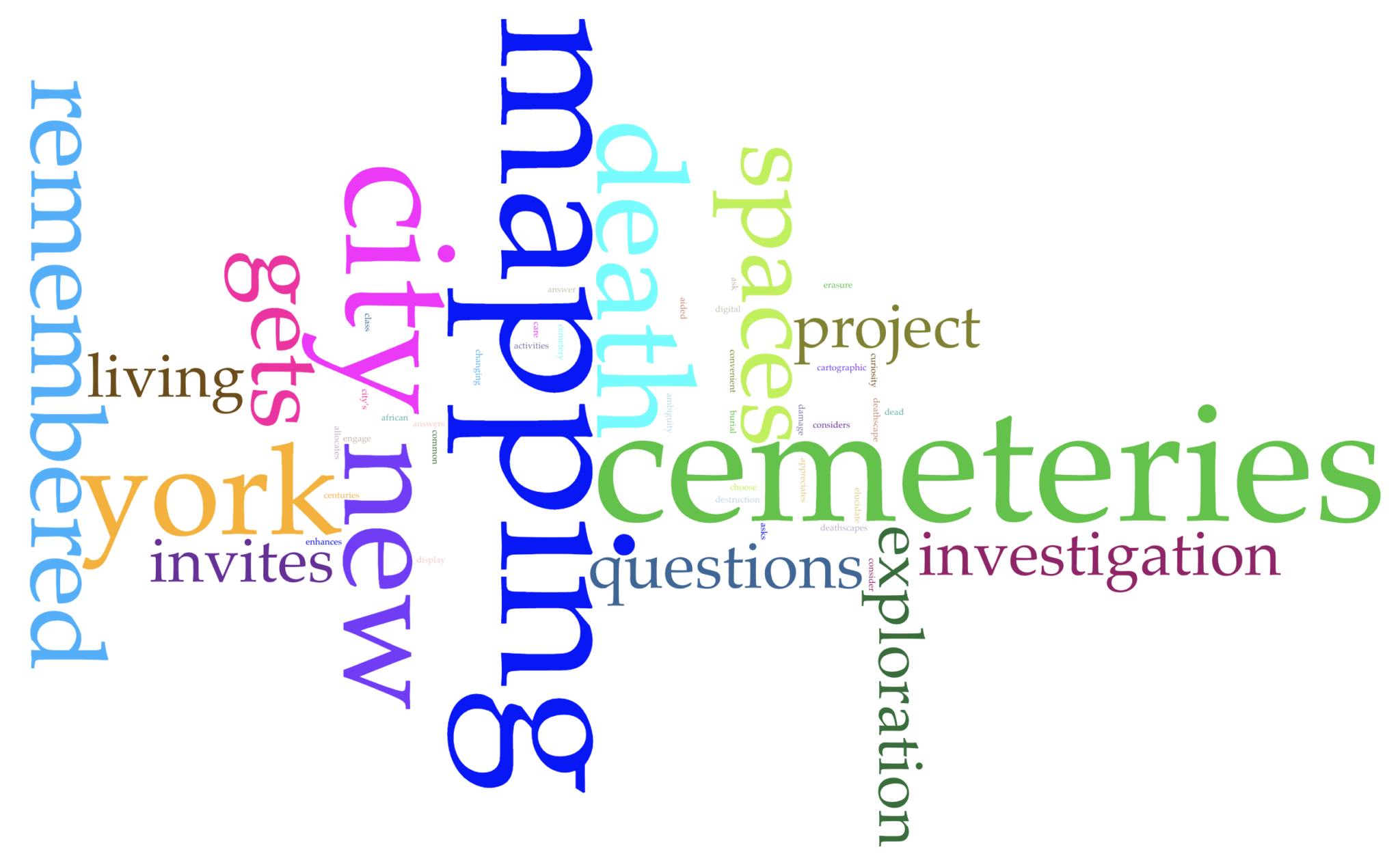
I, Bri, love our project definitions so much that, inspired by Bret’s recent word cloud post, I went ahead and made a Voyant Tools word cloud from them.

Mapping Cemeteries project definition word cloud

Word cloud created from Mapping Cemeteries project definitions written by each team member.

Looking back there are many little things here and there that we’ve changed along the way since February, and we’re always adapting to make sure everyone on the team is being cared for and checking that our expectations and deliverables are realistic. We spoke briefly about our decision to include ourselves as our primary audience, as well as our class. At the time it felt like maybe we wouldn’t be doing enough work, or our work might be too self-centered. But we’re feeling strongly this was the best decision for our group. It’s allowed us to appreciate how much of our project building is about the building and the process. “Done” is going to happen because we will run out of time in the semester, but we’re confident that the state of our project will be something we’re all so proud to share when we get there.

*Posted by Nadia, Lisa, Asma, lane, and Bri.