Personal Blog #5: The Joy of Rebuses

I’d like to reiterate what others have stated – how our projects feel so “real” and “alive” at this stage of the process! Reading Rebus is now at v2.0 and by the time we get to the end of the semester, it might be v.12.0 but that’s the joy of working on digital projects. They are constantly evolving and growing (which is also frustrating because it can feel like they never end). As the website is now feeling like a physical object, there’s a small part of me that wants to keep it to myself, a secret between my team and classmates. It’s not that I don’t want to share or impart knowledge about rebuses, it’s more the pressure I feel as public audiences see our website, and the fear of criticisms they may have.

As the designer/developer, I’m thinking of ways showing the various types of rebuses we’re discovering. Figuring out a design or a coding solution is kind of like solving a rebus. As Bianca and Matt mentioned, the “verbal rebuses” are challenging but also exciting! I’m now wondering if other poets or writers were writing verbal rebuses without realizing it and if they didn’t explicitly state it was rebus, is it still a rebus? I’m also really excited at the different categories of ephemera of rebuses we’ve come up with and the many instances of crossovers. Our Google folder of examples is starting to fill up and we’ll probably end up with more examples than we’re able to add to the website by v.12.0.

And going back to our topic of pandemic life from last week, I’ve realized how much puzzles have helped me take mental breaks. Rachel mentioned at a recent meeting how puzzle activities are usually familial and generational. In my case, I feel like I’ve only really discovered them during this pandemic. Perhaps, the NYTimes can create a data viz to show how many new “Games” subscribers have signed up since March 2020?

Personal Blog Post – It feels real

Now that we have a landing page and are more active on social media, this project is starting to feel more real. It has been very busy so far, especially on the research end of things, but this online presence helps visualize the final project. We needed something tangible and it feels great to have it. Community fridges are becoming more recognized and growing in number along with our project, and I continue to learn about how they have impacted people in my life as well. This week a neighbor told me that he had to rely on a community fridge a few times early in the pandemic, because he was left stranded when his gigs disappeared. Now he volunteers at the same fridge. I realized today that what I am more and more excited about the archive and upcoming steps.

In our team the roles are both consolidating and changing with each stage of the project. I am very happy to be able to take on parts of this project that I am more passionate about, especially writing. This semester I am attending three courses that call for extensive writing and I love it. It is an affirmation of recent life choices. Although I have written and published professionally, it has always been very difficult for me to share personal work publicly, but in this program I have learned to overcome my hangups about sharing my annotations and assignments, or even casual blog posts.

Art, autobiography, and the network effect

What is becoming clear as the Coronavirus Chronicles take shape is the power and significance of young voices when they come together for a common purpose.  In sharing their highly original and creative works, Isabelle, Sarah, and Elise forge a courageous path alongside a growing number of young artists and activists, including Swedish environmental activist Greta Thunberg and Pakistani Nobel peace laureate Malala Yousafzai.  Through their bravery in sharing their direct presence and unencumbered spontaneity, they demonstrate the wisdom of T.D. Suzuki’s famous mantra “Zen mind, Beginner’s mind”.  Through these inspiring works, we learn how the human heart and the human being are at their core vessels of caring, empathy, and joy.

If anything is certain, the impact of the pandemic will be felt for decades to come.  And if the past is any predictor of the future, we might well consider what came after the Black Death of the mid-14th century.  Both the Italian Renaissance and the genocidal conquest of a continent followed on the heals of arguably the most terrible bubonic plague in global history.  What is certainly different this time is the capability of technology to capture and disseminate voices from and throughout the world, most importantly those traditionally unheard and underrepresented.  With these chronicles, we can directly experience the promise and potential to break with the darker patterns of the past.

Five original works have been graciously donated to the Corona Chronicles archive: a video recitation of a free verse lyric poem accompanied by a pictorial watercolor; a video recording of an auto-biographical reflection accompanied by a self-portrait photograph; and a video short combining music, textual narrative, and choreography.

In the untitled lyric poem by Sarah, the poet evocatively describes a series of vivid moments that make up a day in the life of the poet. Setting the stage that verges on synaesthesia with laughter, music, cake, wind, berries, cream, old paper, dried ink, lights, stars, a lake, and the sun, the poet’s attention turns to dreams, another world, and a different fate.  After the night falls and the sun rises, the poet addresses the listener with an exhortation to remember how each of us walks the Earth sharing “life and death, “peace and conflict”, “excitement and sorrow”, ending in a rhythmic crescendo:

“Every footstep on land carries tears and laughter you will never know.
Every breath of fresh air has new hope for tomorrow.”

The accompanying watercolor depicts a girl walking high across a suspension bridge situated above a column of building blocks labeled with letters that together spell “COVID”.  We imagine a world in which life is an adventurous journey, while at the same time we overcome life’s trials and tribulations.

Beginning immediately with a tone of realism and an acknowledgement of lost loved ones and lost old family friends, Isabelle, as the narrator of an auto-biographical video testimonial, recounts the adversities brought on by the pandemic.  Through a brave and vulnerable confession of fallen school excellence, the narrator reaches out to selflessly identify with other viewers in the same predicament after giving thanks to the unconditional love and support from friends and family.  The testimonial ends with a direct statement of support for the viewer:

“Even if I don’t know you personally, I can empathize in the fact that you’re not doing okay. And that’s okay!  There’s a lot of pressure to stay positive in times like these.  But it’s not always easy, and it’s not always possible to stay happy.”

Accompanying the video is a self-portrait of the photographer in an empty school room with the caption “yay class < 3”, thus evoking the celebration of health and safety.

In an expertly edited music video by Elise, introductory text sets the stage for a rock climbing choreography entitled “Reach for the Sky”.  As the rock climber effortlessly glides across the wall to the sound of an up-tempo dance loop, the climber’s agility evokes a creative confidence that leaves no doubt about the limitless possibilities despite being restricted by the pandemic.  Layered meanings emerge of “climbing the walls” as a result of the pandemic, yet eventually overcoming gravitational limitations.  The pandemic may well have pushed us indoors, but the human spirit nevertheless finds a way to “reach for the sky”.

“I would be climbing outside or in a climbing gym more often if it weren’t for Covid…
But I’m stuck at home.
So my dad built this climbing wall in our basement.
The climb I’m about to do is called Reach for the Sky.”

Personal Blog Post: keep moving

Our team meetings are consistently productive and they always move us forward in real ways – this week was no different – which is a great feeling, and a dizzying one at the same time. As Amanda pointed out, we did feel the effects of not having someone assigned in a design role and we got a little bit hung up on how to move forward for the sake of this check-in versus our real end goal. Ultimately, it felt like we were agreeing even when we were disagreeing because we don’t know where the design will end up (it’s in an in-between stage right now), but we agree it will require dedicated time and focus. I will be meeting with our first three contributors to get their initial thoughts before we dive too deeply into that – it is very reassuring to have them along for the journey, rather than guessing and wondering at how it will be received by end users after all of the additional work that could go into it only to get that feedback at the end.

Maggi’s efforts on the multimedia front this week were above and beyond, and they also showed us a sense of how much is possible on the design front. I feel a bit naive saying this now, but it’s apparent how many decisions there are to be made about every aspect of every feature. At some level, I knew this, but it is coming up again and again. And it’s an argument for speed and committing to rapid decision making, as argued for in the reading that framed our semester. Obsessiveness, or at least chasing the illusion of completion, can weigh you down and be unwise at this stage, but it’s still hard for me to let go of.

In our next phase, in addition to expanding our submission based domestically, we will be seeking a small number of international submissions in order to test the “state/province/region” field of our form flowing into the map. Feeling much more confident with the consent form makes this relatively easy. Pressing for a due date at the next level of scale with networks of students once removed from me directly will be an experience – to see response rate and whether they are sufficiently hooked by the concept. It also makes it all a lot more real – both exciting and terrifying at the same time.

Lisa’s Public Journal – Week 8 – More Research

This week was research and more research.  Bret made me aware that the NYPL will send books to GC students, so I made a request for a copy of the Jenkins Worth biography and the planning report that the NYC Common Council created to commemorate the memorial.  It can take up to three weeks for the request to be processed, so I am unsure I will be able to rely on getting it in time.  However, it’s good to know that I will likely get it at some point.

We need to populate our website’s top navigation timeline with more data.  My research focus for this week was on the broader history of New York City.  Bri had already done super work recording some of the great moments in the NYC deathscape, like the fact the city banned burials below 14th Street in 1839, or that the state allowed the purchase of tax-free land for cemeteries in 1847.  I focused on demographics (for example, how huge surges in population growth affected culture) and infrastructure (how the opening of the Erie Canal gave NYC a direct water route to the content to the Midwest).  In our team meeting tonight we agreed that we would need to winnow down the number of data points that we’ll use in the timeline, but that we’ll also want to memorialize the bulk of the content in another way.

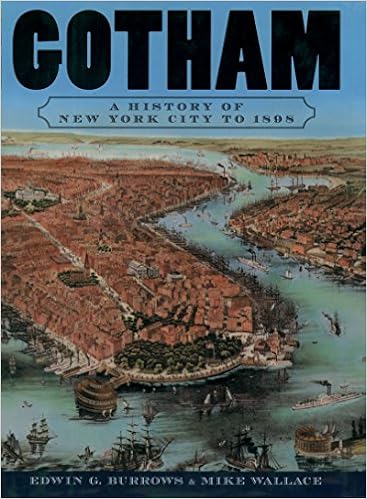
The biggest challenge is focus.  I started reading Burrows “Gotham: A History of New York City to 1898” on Friday night, promising to keep to the index and just focus on the deathscape …six hours later I had completely forgotten my promise and was well into just reading!  So now, I have mapped out a set number of hours a week, in three-hour chunks, through 15 April.  I have also fired up Zotero, to keep me on the mission.  [There is nothing like tweezing citations to focus the mind.]  I love reading and doing research, but with such a short timeframe I know I need to keep it on the core aims of the project.  Discipline!

Cover art from

“Gotham: A History of New York City to 1898” or where Lisa spent her Friday night.

Personal Blog: Commons Site (and Clever Title) TK

Inspired by our class and group discussions in last Thursday, we decided our project would benefit from having a companion WordPress site on the Commons. We already have a Commons group where we share all of our files, keep track of deliverables, and conduct most of our conversations via forum threads. Creating the Commons group was fairly simple, and I only had to check a box to create the companion site: So. Simple.

Yes, and no. A weekend and various additional hours later and our site exists, but I’m also not quite happy with it. In our meeting this evening, my group was very supportive of what is built so far. And I know I shouldn’t be quite so hard on myself as this is my first time ever building a website. And yet…

I think the content we’re building on our Commons site is very solid already. We’re envisioning this site as a space where we can better address our audiences’ pedagogical needs–going more in depth about the making of/behind the scenes of Mapping Cemeteries and explaining our thought processes and decisions along the way. Indeed, we’re finding we can reuse much of what we’ve already contributed in our class blog (aside: this post will definitely be making its way into our Commons site blog, and in posting on our class blog I will be experimenting with my ability to simultaneously post there too, rather than posting twice and backdating–see my comment to see if it worked!).

We’ve engaged comments on our blog page, and we’ve engaged Hypothesis collaborative annotating on every page of our site. We also have a “What We’re Reading” page where we are highlighting articles we are finding particularly influential in our research, which we are linking to via Hypothesis–so we can show our audience our own notes and also encourage them to contribute their own annotations. Our current issue is that an article we’ve found fundamental to our understanding of necropolitics isn’t open access. As a student at the Graduate Center, we have access to the PDF of the article via Project Muse. Hypothesis has a suggested tool where I can drop any PDF and make it accessible for public annotating, and I’ve successfully done so, but if we make the link live, then I think we’re violating copyright. We need to discuss the ethics of this with a librarian. Update to come. So for now our Commons site remains private. But I will share it with the class when it’s ready.

Prototype Success! Now, Let’s Take a Break

We had a busy week prepping for the debut of our prototype for the class. Things feel like they’re chugging along now as we’re confirming workflows and starting to consider design decisions. I’m so inspired to see how each of the strengths of my teammates continue to come together to make this project a success.

In our Sunday meeting, Maggi impressed us all with her designs for our site mast head as well as the work she did to customize our student contribution videos. We were blown away by the attention to detail and creativity! Phil was also instrumental in getting the site in working order to show off to everyone this week. The vision is coming together! We still have some of the creative decisions to make around our color palette and logo. Looking back, we probably should have formally assigned someone the role of graphic designer…

Another discovery was Google doc overload. We ran into trouble finding our “gold source” information to work from with multiple versions of different plans scattered around gmail accounts. This week was all about getting organized after making a healthy mess with our plans and ideas. I even assigned myself the task of creating a visual workflow of our submission intake process. This will hopefully keep everyone on the same track so nothing is dropped along the way. This kind of documentation will also be helpful for the next phase of the project beyond this semester.

Needless to say, we’re ready for a recharge. Spring Break comes at a great time for us as we await additional student submissions through outreach to our networks. Will we meet our ultimate goal of 20 submissions?… stay tuned.

Personal Blog post: Media Management

This week was all about editing and media management. Though we only had a few assets, these proved to be perfect to test out our streamlined process of obtaining submissions, processing them, and uploading a finished product on our site. While Canva became a great digital tool to create simple yet effective graphics for our home page, Adobe Premiere Pro and Adobe Audition became essential in creating cohesive and uniform video formats and cleaning up audio.

As the media producer and manager, I have to keep in mind 1. students/schools ‘ digital and technological limitations and 2. not assuming that all student/contributors are technologically savvy; knowing and understanding how best to shoot and submit their recordings. It’s great to have teammates that remind me. I’m grateful to Karyn’s three amazing contributors, the young ladies not only supported our project and provided content, but their feedback, along with some of the parents regarding consent forms, was invaluable!


My goal here is to make these student contributions the best they can be!  As we move forward I have no doubt we will be receiving unique and creative media from our core audience.


Personal Blog – A Search Engine Occurrence and More

This previous week, I searched “19th century rebus collection” on Ecosia and found that, believe it or not, our group’s project proposal was the first result! I was afraid at first that it was a result of Ecosia harvesting my data (something I figured they were above, or at least moreso than most search engines not named DuckDuckGO), so I asked for a second opinion. Indeed, the proposal appears within the first two search results more often than not.

That aside, I’ve begun revisting one of my favorite texts, Codex Seraphinianus, in search of more esoteric rebuses. It’s interesting to look for them in a book that is written in a non-existent language, and indeed, many of the images I’ve taken are less definitively rebuses than those, for instance, that I took from A Complete Guide to Heraldry. This has gotten me thinking, as well as with our group’s discussion of verbal rebuses: can a non-rebus be interpreted as a rebus?

Additionally, I’m still working on my heraldry interpretation and iconography guide. It turns out I’m going to need to be far, far more exhaustive than I had originally thought, and I’ve had to branch out beyond the Complete Guide to research what certain symbols mean. It’s impressive to see just how many different sorts of creatures are represented in heraldry, in part because of the fact that many texts only include mentions of animals that exist predominantly in Western European heraldry. It’s also important to keep in mind that an animal’s name in other languages can allow it to be more versatile in rebuses in those languages, so I’m thinking about compiling a list of translated names and synonyms for the creatures and icons in my guide.
