NYC Community Fridge Archive – Landing Page

We are excited to present our new Landing Page on the Commons.

After talking in class last week, we realized that we needed a landing page where people could learn more about the project and find all our contact information. Even more important, the page is on the CUNY Commons, stressing the fact that our only affiliation is with our university.

I just want to share my appreciation for all my team members:

  • Montage for creating the landing page, including the layout
  • Lola for creating our beautiful logo
  • Allison for managing social media and outreach with the fridge organizers
  • Jean for proofreading all our text and making sure it’s not only readable, but a pleasure to read it!

And also, thank you Maggi for interviewing me! We have your podcast episode on our Homepage, we thought it would be a great idea to give people an introduction to the project.


Elena’s Journal – It’s (A)LIVE!

I’ve been working on this project for six months now, writing the proposal for the Intro to DH class, finding a team, re-writing the proposal with them, then the DMP, the Outreach and Social Media plan, and – as I wrote in my last post – managing people, with all their different talents, personalities, and voices.

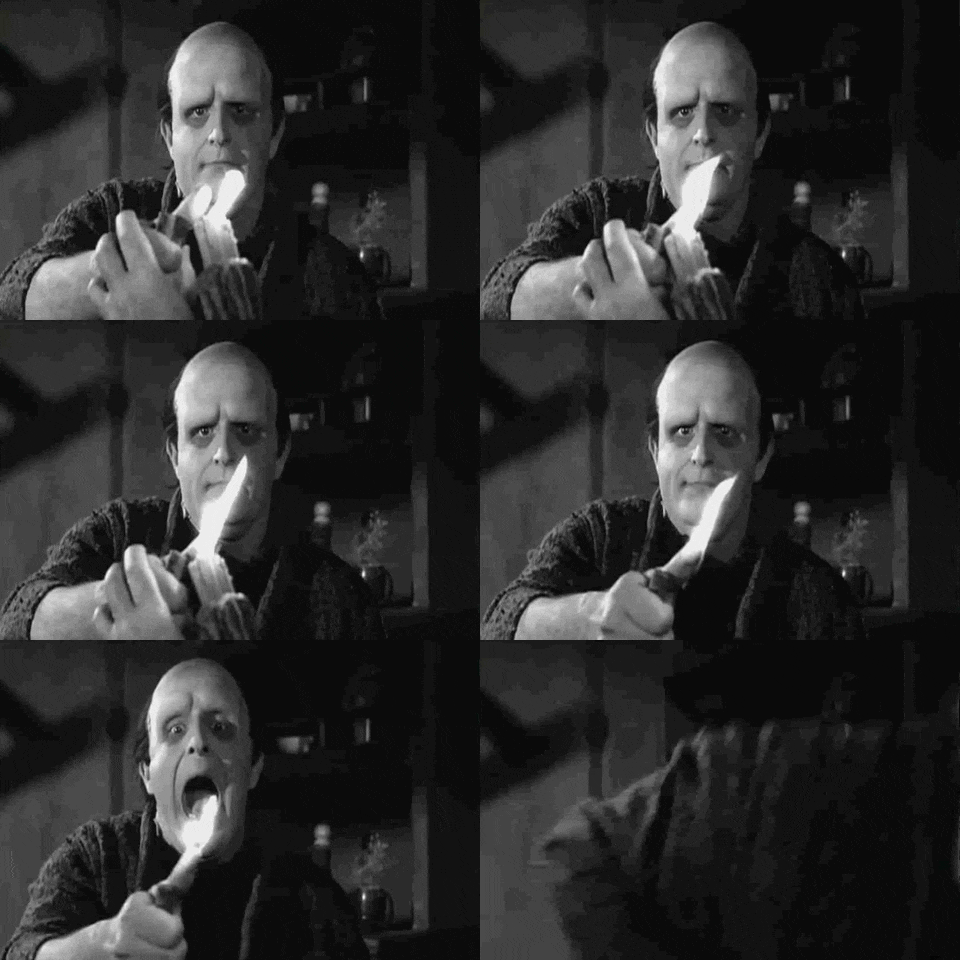
Considering this, it might be weird to say that the project finally feels real. Now that we have a website people can go to, even if it’s just a landing page on the Commons, I feel excited and incredulous like the doctor in Young Frankenstein.

So far, we’ve talked on Zoom with four community fridges from around NYC, who have given us precious insights on how the NYC Community Fridge Archive can help them in their mission. Talking to the “Fridge People” is part of what’s keeping me grounded and sane: hearing them say that they like the project and would love to contribute means that I wasn’t crazy for creating this project – and for dragging four more people into this.

Today, I’ve posted for the first time on social media. Nothing fancy, just sharing the logo and some basic information about the project. And now, every time I get a notification on my phone, I get excited. It might be ridiculous, but it’s true. This archive is our weird Creature, made with bits and pieces of software, data, and most of all stories. I’m really looking forward to having the Omeka site up and running, so we can start collecting people’s submissions!

In the meantime, check:

Give us some social-media love and spam these pages to all your friends and family!

Corona Chronicles Working Prototype

https://corona-chronicles.world/

*Color palette and other design details are still being finalized.*

We’re so proud to share our working prototype of Corona Chronicles with you all. The team has been working hard to pull together and edit student submissions before we do our next and larger phase of outreach. It was important to us to have student examples to present at this stage, and we’re excited to continue to add to our collection and perfect our intake process. In the meantime we hope that the stories from Isabelle, Sarah, and Elise spark empathy for how students have been impacted by coronavirus over the past year.

Student submissions will all live on the home page, and you can toggle between our current pages in the top left corner. While we’ve been working with our student networks to spread initial awareness of the project, we hope that students will visit the site and be able to upload their entry through the linked consent form under the “Add Your Story” page with the support of their parent/guardian.

Under the “Resources” page, we plan to document a list of projects and articles that inspire our work as well as mental health and well-being support services for students and parents. Our live map (still a work in progress) of student submissions will also be displayed on this page and will grow as we continue to hear from students around the country and world.

Lastly, we’ve linked our social media accounts and email address in the top right corner for students to connect with us if they have any questions or want to learn more about our project.

Lots more to come…

Reading Rebus Landing Page v.2.0

readingrebus.com landing page v2.0

readingrebus.com landing page v2.0

As much as we loved our landing page v.1.0 (with the Reading Rebus logo animation), it was time to add more information about our project to visitors. Please click to revisit readingrebus.com v.2.0. We start off with a headline description of the project that includes our own rebuses (hint: hovering over the symbols with your mouse will reveal the letter/word/phrase). This little bit of interactivity will help people understand how to interpret rebuses (ex: the “hand” is often used for “and” with a silent /h/) and it offers a preview of how we’ll eventually treat the ephemera added to the website collection. Since many people are not familiar with the term, we also added the dictionary definition of the word “rebus” at the top.

Our longer description of the project now includes information about the origins of rebuses and its uses throughout history. Our research has expanded and we are now planning on including more genres, periods and languages, while still focusing on European and American examples.

Finally, we have a sneak preview of rebuses we’ve discovered–the images are quite small at the moment–but hopefully, this generates excitement and a desire to return and see the full website soon!

–Reading Rebus team: PB, BFCC, RD, OK, MR

Mapping Cemeteries: Site Preview

We (namely, Nadia) are building our project in GitHub Pages, and have yet to publish the site so far. But here are some screenshots to show everyone of the direction we’re heading in.

Splash Page

The first page you see is a map of New York City. We will have an interactive pin for each of our locations. Locations may be a combination of actual and imagined geographical coordinates. Some of what we wish to map–in this phase and beyond–may be unmappable. For example, exact locations are no longer known, we want to be respectful and not draw unwanted attention to closed sacred spaces, or the spaces simply resist the limits imposed by a map–or some combination thereof. Hovering over a pin will show you an image and let you click through to the location’s page.


Screenshot from the wireframe of the Mapping Cemeteries project for the "Splash" (or Mapping) page.

The “Splash” page is a map of NYC and has interactive pins for each cemetery.

Timeline Page

We are experimenting with both horizontal and vertical timelines. The horizontal timeline will help position our research and locations within the broader context of New York City history. It will include dates and very short blurbs pertaining to infrastructural milestones (e.g., Croton Aqueduct), legislation (e.g., burial bans), epidemics (e.g., yellow fever), and times of significant population growth (e.g., key Census count years). The vertical timeline will focus on our specific locations. We envision it as a conversation between our locations/us, tied to specific years, that explores the connections we discover between them. Each of our locations will be represented by a category tag and gravatar. Clicking “Read More” from a pin in the horizontal timeline will direct the user to the full location page.

Screenshot from the wireframe of the Mapping Cemeteries project for the Timeline page.

The timeline page has a horizontal interactive that gives broad historical information about the NYC deathscape. The vertical contains our discreet scholarship. Both are interactive.

Location Page

Each location will have its own page. These pages will feature a combination of historical and present-day images (when possible), and the content will take essay form as we explore each location in depth.

Screenshot from the wireframe of the Mapping Cemeteries project for the War Memorial Cemetery page.

Each of our cemeteries will have their own page. The bulk of our scholarship will be contained within these five pages.

About Page

Our about page will highlight key information about the project and about us, as well as ways to contact us.

Screenshot from the wireframe of the Mapping Cemeteries project for the "About" page.

The “About” page has information about the project and its participants.

Commons Companion Site

We are very intrigued by Bret’s suggestion to build a site on the Commons after our discussions last night–as a full group and in our breakout room. We are already using a Commons group as the primary means of communicating and sharing files. We (namely Bri) will start building a public-facing Commons site tied to our private group page. We envision this site as a “behind the scenes” or “making of” view of the project. We can use much of the content we’ve already blogged for class. We can also include a more in-depth analysis of our philosophical approach and fully address blockers we encounter while building the project. We will enable comments on our blog posts, and we will also provide a “What We’re Reading” type page with links to articles shared via Hypothesis to engage our audience in building a collective understanding of key articles shaping our theories. We may even enable Hypothesis across the whole site so our audience could engage with any content they find interesting or have more questions about. As such this site would fulfill much toward our pedagogical aims and also serve as a means of audience outreach beyond the limited scope of social media platforms. We will link to the Commons site from our project site About page, and our Commons site will link to the project on GitHub pages. Depending on the social media post, we can drive traffic to one or both of these sites.

Social Media Links

Here are links to three of our social media accounts. Please follow us.

Instagram: https://www.instagram.com/mappingcemeteries/

Facebook: https://www.facebook.com/mappingcemeteriesnyc

TikTok: https://www.tiktok.com/@mappingcemeteries?lang=en


*posted by Lisa, Nadia, Asma, lane, and Bri.*
Personal Blog #4: Big Questions and Small Tasks

This week for me was filled with small tasks and big thinking about our project. I’m working on the website draft which is a lot of small technical things to figure out but at the same time, a lot of thinking about the bigger issues of the project. Our project manager, Bianca brought up some “anxious” questions that have us thinking about our criteria for choosing rebuses, why we are even doing this in the first place, and will we be able to have enough examples on our websites to demonstrate the claims put forth in our proposal? Fortunately, I think we all felt better after Micki reassured us that it needs to be a work in progress. Rachel asked “why rebuses?” which has now become the start of every thought and task having to do with this project.

All the team members seem to be falling into position to tackle their roles and interests. I’m really happy that the project is going in directions that I would never have been able to do on my own like research into French rebuses and heraldry. Even though it broadens the initial idea, I’m confident the website will be a useful tool for learning about rebuses. I’m also confident that the website won’t be perfect and the research won’t be complete but it’s all good!

Lastly, I find myself needing more time – to research, gather, question, write, design, etc. Wouldn’t our projects turn out so much better if we could work on them full-time 🙂

Rachel’s Rebus Writings – Week 7

Very short diary this week to say I am feeling a bit like a dead-weight! This is my last week of full time work during the semester, which has been a challenge in the way that wrapping up a DH project certainly will be in the near future (“how will I know when I’m ‘done?'”). There is much to be done and undone, and I am just at the acceptance phase where I understand that there is no way to possibly tie up *all* of the loose ends, try as I might – sound familiar? Adding to that dead-weight feeling –  I was not feeling at my best over the weekend and was not able to contribute or focus at my usual level, so I am happy to be over that hump too.

Regardless, I did manage to do some outreach last week and have started to do some of the related reading/notes for the essays I have tasked myself with. Bianca is wonderfully guiding us to ask “what’s the scholarly point” and I am starting to get into my happy place where the information we’ve been collecting starts to make more connective (and collective, I hope) sense. It has been helpful for me in really refining the inquiries we’re making beyond my current blob of a “collection of foreign and interesting rebuses from the 18th century.”

My goal for the upcoming week is to exhale a bit (work has been a lot for all of us, work at an early stage startup in a pandemic is too much for most humans who want to do much else, including myself), gather more notes on the ludic aspects of rebuses (while solving some more of our gathered french rebuses). I may also go spelunking for a few more rebuses in Wikimedia Commons, as they had many items tagged with the term (and I can get some wiki editing out of my system in the process, which just feels good to me!), but I cannot commit to this last bit this week. Next week will clarify a lot about my capacity in the weeks ahead, as we start writing and solving and putting the site together!

Lisa’s Public Journal – Week Seven — Research

This week I have spent most of my time researching William Jenkins Worth.  I was able to find only one biography of him, “General William Jenkins Worth: Monterey’s Forgotten Hero” published in 1953, which is now out-of-print.  Instead, I’ve been reading contemporary accounts of his life and death.

The New York Times ran several articles about the festivities surrounding Worth’s interment in the monument at 25th and Broadway.  The account from 26 November 1857 is profound in its detail; an entire broadsheet, devoted to the minutia of the day.  From the number of horses that drew the casket up Broadway (“sixteen gray horses with black plumes fasten above their heads”) to the impressive number of documents that were included with the casket (I need to understand why Comptroller Flagg’s Report for 1854 was deemed as necessary for the General’s afterlife as a bible) to the many dignitaries who spoke, to the dramatic masonic rituals.

The challenge is to share enough of his biography to explain why he received the honors that he did … only one of two people to be given a public reliquary in NYC, President Grant is the other … and put this tribute in a greater context.  Why does society choose to exalt some and neglect others? The reporter who penned the story explained their reverence thusly:

“There was no spot, honorable to the wealth and magnificence of this emporium or worthy of the public services which he had rendered … But, from this day forward, the pilgrim of his genius and patriotism may here kneel in thankfulness, reverence, and admiration, at his shrine.  The youth of our counter, passing and repassing this monument, will hereafter pause to peruse the record engraved thereon, of the virtue, service, and fame, of a man whose life presents a beautiful illustration of the institutions of our country, having raised himself from civil life to the highest rank know in the army; and every gradation in the chain of his elevation having been due to the fidelity of his adherence to professional duty.”

I sat across the street from that monument for several hours last week.  The city felt almost normal, what with the hint of Spring and warming weather.  Some hundred souls passed the obelisk and not one paid it any mind.  I was reminded that even the most famous among us can be forgotten.

Worth Memorial March 2021

Worth Square, as seen from Madison Park


“THE Obsequies of General WORTH.; Address of Mayor Wood. Dedication of the WORTH Monument. Imposing Procession.” 26 Nov. 1857. Web. 17 Mar. 2021. Link: https://nyti.ms/30RaW9e

Personal Blog Post

It has been really wonderful to learn about how these fridges operate and about the people who make them happen. While I love learning about these people and the communities they serve, I also find it disappointing that these fridges need to exist to feed people. The joy that I feel watching these people come together to serve and even create communities, is always matched with a feeling of profound sadness that in the wealthiest nation in the world (a place that produces so much food waste) so many people have to rely on these fridges. I hope that this archive and the community it serves continues to thrive past the pandemic, but also that this project becomes more about eliminating food waste than serving an active need from communities.

Last week I finally felt like I had a concrete picture of what our archive might look like for the first time and it was a great relief. I think I was more worried about arriving to a final ‘product’ than I realized. Now we can look forward to building on our vision and define how we approach the following steps. It is not easy to work on a project that involves diverse groups from the community and a diverse team of different backgrounds, skills, availability or commitment. I think we have fallen into some level of routine in accomplishing assignments and we have a shared vision. The next challenge might be for us to keep things simple and manageable when working with such a large and diverse group of participants. I am absolutely delighted that I got to design our logo and that I will be more involved with the design end of things once we have our site up and running.