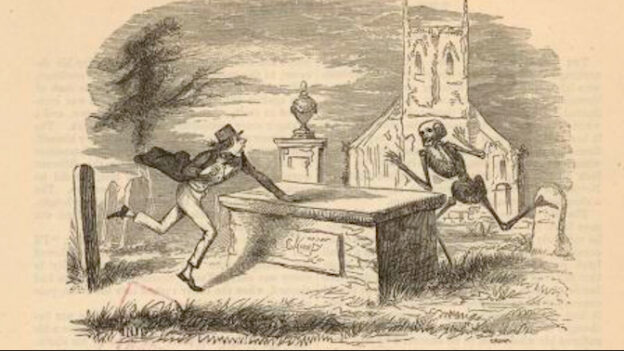
Cartoon of man chasing skeleton.

Lisa’s Public Journal – Week Fourteen — The Final Hurtle

Ghost Hug. You can't feel it but its there.

“File:Ghost Hug chalk writing on Hawthorne during Coronavirus pandemic.jpg.” Wikimedia Commons, the free media repository.

When I stood to write this final journal (yes, stood …I’ve worked at a standing desk for years), I struggled with how best to end this exercise in public journaling: would it be a final personal narrative, or a reflection on the project itself, or something more esoteric?  In the end, I decided to focus on what I believe made the project a success, and that can be summed in one word: cohesion.

For people who have studied group dynamics, the effect of cohesiveness is key to productive outcomes.  Teams generally develop in stages*:

  • Forming (emotions like excitement, questioning behaviors about a person’s place within the group, and task formation).
  • Storming (emotions like frustration when blockers begin to appear, arguments over direction can happen, and tasks need to be revised).
  • Performing (emotions like comfort and acceptance, communication improves, productivity improves).
  • Norming (emotions like satisfaction, fluidity between tasks and adjustments to support needs, skills improve and success is celebrated.
  • Adjourning (emotions like anxiety and loss, some members may increase their productivity while others step back, task closure and celebration).

Our group was tested several times along the way, and we had to move quickly from forming to storming.  Our first test was when we realized we would need to radically rethink the initial proposal, as it had relied too heavily on the work of a single academic.  The second was when we struggled with how to define our audience.  If both cases, our ability to be speak openly and to listen mindfully allowed us to pivot gracefully.  It was helpful that several of us had worked together before this class, so trust had already been established between some members of the group.

The ability to pivot and then to see the work grow from those decisions led us to reach farther.  The creation of the Making Mapping Cemeteries site was driven by our desire to leave a roadmap to future scholars (DH practitioners being one of our audiences), and wanting to engage using different platforms led to the creation of the Mapping Cemeteries: After Life podcast series.  While these choices did significantly increase the workload, they also forced us to stay continually engaged with each other via email, Zoom meetings and our Common’s community site.

We are now moving from norming to adjourning.  Coming together to write our final group report [https://dhpraxis21.commons.gc.cuny.edu/mapping-cemeteries-final-project-report/] was bitter-sweet, since it so clearly signaled that our team in its current incarnation was drawing to a close.  However, our last team meeting was also hopeful, in that we all expressed interest in staying connected to the project in some way and to coming together to finally meet “in the flesh” and do a group walk of our locations for a walking tour.  Our class is over and our class deliverables to it have been met, but our relationships to each other will continue.  That is what cohesion builds and I feel blessed!

*I am referencing Bruce Tuckman’s work here. Resource: https://infed.org/mobi/bruce-w-tuckman-forming-storming-norming-and-performing-in-groups/

Cartoon of man chasing skeleton.

Tom pursues the skeleton of Old Grindstone around the graveyard, c1857.

Due: 13 May 2021 (published 25 May 2021).

Catchup blog #1

I think I have 5 personal blogs left to write, which pretty much coincides with having built an almost-fully functional website in the last… 3 weeks. I honestly haven’t had much to write since my topic modeling posts — the update each week is that I am neck-deep in coding, which is a state that I alternately love and hate.

I hate it because it involves hours and hours of sitting, often so engaged in a problem that I forget to move or drink water for an unreasonable amount of time. I hate it because it leaves my body restless and my brain knackered. I hate it because the emotional landscape sometimes involves great swathes of frustration with just pinpricks of triumph before I turn to the next tangled problem.

I love it, though, because it really is like learning a new language. It’s a language of functionality and precision, and of breaking the problem I want to solve down into a set of tasks that a computer can accomplish. I’ve enjoyed learning over the course of my degree that there’s rarely just one way to do that. There may be one way that’s the most performant, one that’s the most mobile-friendly, one the most visually pleasing, or one the easiest. Beyond that, there may be one way that accomplishes what you really intend and one that seems logically sound but ultimately fails (for example, select all the women in this dataset and select all the not men in this dataset are equally easy tasks for a computer but certainly not equal questions for a researcher — intention is key, as is a data structure that allows you to ask exactly the question you want).

Sometimes these different  “best ways to break down a task” overlap, sometimes they don’t. Sometimes I have the knowledge and bandwidth to make an informed decision or improve on an old way of doing things, other times I’m so relieved to hack out a way that just WORKS, I don’t even think about the others. That’s definitely a plus one for collaboration, since looking at other peoples’ code often teaches me about the ways I haven’t chosen.

I love coding because I get to not only think about all of that, but actually do it. I hope it never gets old for me to write out text commands and see them bring dynamic shapes and colors and movement and information to life online.

FOS* Group Project update: crunch edition

This group project update from last week is coming in no-so-hot because we’re working hard to get everything squared away for Thursday! There may have been some scope creep, and some of us are wondering for the second year in a row what happened to April…

We met all together on Monday to finalize presentation details and discuss feedback from the class practice session. Kevin has been working hard on the presentation and a few last minute asks for the website (like a little courthouse icon to denote landmark cases). Martin has been helping with the presentation script and with some important last minute manual data work. Joanne is continuing to work on making our text data perfectly ready for web display,  as well as working on the map and timeline. And Eva is working on the sort/filter/display functions for the website’s explore page.

Personal blog: Reflection

Thursday’s dress rehearsal reiterated all of our hard work during the last few months. Listening to Karyn’s excellent presentation reinforced our mission and values. Seeing our website overflowing with multimedia stories from the US and international students fills me with so much pride and joy. This has truly been a digital humanities project, one that includes a global and inclusive perspective. With these in mind, we faced so many questions, from hosting and design choices to privacy, safety, and service to and for young students. It’s easy to forget the struggle we faced, the hard decisions and compromises we had to make to create, sustain, and make this project one that has the potential to continue for years to come.

As I think back to my role as the media manager, I can confidently saw our contributors are truly thoughtful, talented, and genuinely much more compassionate and thoughtful than how most adults see them. It’s no wonder that they have chosen to express their experience in various ways. Their works are simple but thoughtfully made; their message is heard/read loud and clear. The practice of editing these videos and enhancing their images and sound reminded me of my work with other creative and wise students at the Youth Channel. I miss my work there, but I’m happy to have collaborated and amply their voices/stories.

I wonder what their parents and educators would think once they view the Corona Chronicles!


Bianca’s final post: ReadingRebus as Recreation in difficult times.

In the endpapers of an edition published in Venice 1556 of the Spanish best-seller La Celestina, an anonymous reader has inscribed the following explanation of “pintando motes” or “painting words”: “Lovers in Spain are wont to paint words as refreshment [relief] from/of their passions [sorrows].” The annotator provides three examples of this practice, with their explanations: “Dado me as dado Coraçon cuydado”; “Asperas piernas Elvira as”; and “Consuela te Coraçon que el Mundo Rueda.”

Our rebus collecting and research has largely focused on the interpersonal dimension of puzzle making and solving: the rebus used to create an inner circle of decipherers, to make pedagogy more palatable and memorable to students, to circulate political opinions in an increasingly centrifugal and global public sphere, to attract consumers to industrialized products, or to record sentiments between intimates.  In all these contexts, the rebus rehearses and resolves, momentarily, the inherent problem of signification; the rebus foregrounds the challenges of textual communication but promises the reader a monolithic (and monolingual) solution as designed by its creator, rewarding them with a delightful if transient sense of proficiency and control.

Our early modern explicator, however, suggests an additional function for the puzzle: “recreaçion” of a different sort.  Somehow, s/he does not exactly explain why, the process of painting words about their condition allows lovers—at least in Spain—respite from lovesickness or grief.  At the same time, recreaçion, like the early modern English equivalent, implies both the possibility of a restorative ease/easing and the “growing afresh” or “increase” of those passions: a renewal of the desires that led to this solitary translation from verbal to visual in the first place.  The rebus articulates and instantiates the writer as an amorous subject, even without an audience.  Despite its isolation, deriving from an unrequited passion, and even in its most limited circulation, the rebus functions as what D.A. Miller terms an “open secret”: for example, the “harsh pains” of Elvira, as expressed covertly, establish her not only as a lover but as a writer who both precedes an audience and controls its access and response to her painted words.[1]  The anonymous commentator, on the other hand, establishes their own proximity to such authorial subjects, by providing the solution directly below the rebuses, suggesting their own ability to see the supposed interiority inside the puzzle and the person from whom it emanates.

Nonetheless, we are given the sense that Rebuses–as well as those better known salves, Reading & Writing–can function as solace, as refreshment, in a period of solitude and deprivation.  I know ReadingRebus–both our group and its project–has served that purpose for me, as has the class as a whole, and for that I feel profoundly grateful to everyone in it.

[1] In his venerable “Secret Subjects, Open Secrets” (1985) D. A. Miller describes secrecy as the “subjective practice in which the oppositions of private/public, inside/outside, subject/object are established, and the sanctity of their first term kept inviolate. . . . [T]he phenomenon of the ‘open secret’ does not . . . bring about the collapse of these binarisms and their ideological effects, but rather attests to their fantasmatic recovery” (Miller 1985, 27). Through a Foucauldian reading, Miller goes on to explore the workings of the open secret in the 19th-century novel, its role in creating the liberal/carceral subject, and its centrality to the maintenance of the social order, as “the very genre of the liberal subject . . . the genre that produces him, the genre to which, as its effect, he returns for ‘recreation’” (33).


Reflecting on MC’s team experience

I can’t believe the semester is almost over!!! This journey has been so rewarding but so exhausting at times. And I’m happy we are getting to a point where we get to wrap things up, look at what we created and present it to other people. I feel like my team has done amazing. The way we have managed to work together since the first day we became a team has been very eye-opening to me and now I won’t ever lower my standards as to how group projects have to be 🙂 Everyone worked so hard on their research and their role in the project while being so graceful and compassionate, and I appreciate that a lot. I usually have the busiest Tuesdays and Thursdays during the week, since I work from 9 to 6, have class 6:30 to 8:30 and then group meeting at 8:45. Although by the time I got to our meetings, I was drained, the team was always understanding and appreciative of the progress I made, whether it be on the website or my research. Last week, Bri has the brilliant idea to create an inventory of the github website to look at it together and have a list of what still needs to be worked on/changed. I found that extremely helpful and it allowed me to make a lot of changes to the website. It now has such a different look and feel and as Asma said “It’s like watching a child grow”. I’m just very happy that the team is liking where the website is going and I appreciate all the feedback.

We recorded two more episodes for the podcast. This allowed me to combine all my data points and think more about how I wanted to present them. We then talked about our vertical timeline and each chose three data points that we wanted to include.

I’m very excited for the Digital Showcase Presentation!! Bri has done an amazing job on the slides and I can’t wait to see it.

I also wanted to congratulate all the groups for their amazing projects. I looks forward to seeing your presentations.

Next step musings on DH dissemination at scale

Returning to the topic of scale in relation to the impact and efficacy of our projects, a couple of questions arise at this juncture:  To what extent should technology automation and systemization play a part in the development of DH projects?  Additionally, to what extent should and can the DH community at large serve as publishing gateways and aggregators in order to scale the impact and the investment of time and effort of DH teams?

Having divided our approximately twenty-five person class into five teams with roughly five persons per team, collaboration at this scale has allowed for a relatively minimal effort needed for systematizing and automating workflows and/or data/media pipelines.  One wonders how  our collaboration and objectives might have changed if instead of five projects, our class had been divided into two projects with roughly twelve to thirteen collaborators on each team.

In relation scaling the dissemination of academic work, traditional academic publishing has often involved large scale publishing networks and pipelines.  The traditional publishing industry served as a dissemination platform at scale for scholarship largely authored by individuals.  In the new model, digital projects are often created and built by a team of collaborators and are deployed and disseminated without an intermediate publishing network.  While individually authored scholarship relies on informally associated collaborators, including among others librarians and colleagues, the technical, multimedia, and analytical computation tools involved in digital projects bring together a number of specialized and dedicated roles in a more formally organized DH team.

Perhaps another path would have been to divide the class into three or four teams consisting of one or two digital projects and one platform infrastructure team that would be dedicated to developing or integrating projects with infrastructures and networks, thereby providing the intermediate agents traditional publishing once provided.  The efforts of the team would necessitate the incorporation of research, technology skills, and knowledge that would serve as  a part of the DH toolkit going forward.  Members of this infrastructure team might divide their time between the digital projects and the infrastructure efforts.  As an additional benefit, more cohesion would develop within the larger group as a whole and potentially more interconnection would emerge with the DH community at various levels.  A effort of this kind raises the question of the extent to which infrastructure is a sine qua non aspect of the DH discipline and not merely an object of study as a DH subfield.

While a monolithic platform for the dissemination of digital scholarship would be neither efficacious nor desirable, technology solutions that facilitate an interconnected ecosystem of digital work would offer a way to leverage labor and thus amplify the impact of DH efforts.  Critical theory and transdisciplinary understanding underlying DH suggests that while technology is by no means the panacea claimed by tech futurists, technology solutions might nevertheless offer opportunities for furthering the humanities in general and digital endeavors in particular. 

Along these lines, one might well imagine building out and interconnecting already existing networks of DH databases that aggregate digital works constructed by DH teams.  Given how the Internet has long since outgrown the file based hypertext architecture designed by Tim Berners-Lee just over thirty years ago, the challenge becomes how to represent and promote temporally-based user experiences involving video, hypermedia, and dynamic interactions.  One possible approach in this effort might be to build off the architecture underlying the Internetworking project SOLID, another endeavor led by Berners-Lee to store “data securely in decentralized data stores called Pods. Pods are like secure personal web servers for data. When data is stored in someone’s Pod, they control which people and applications can access it.”

Putting Together Final Thoughts

It’s so hard to believe that we only have a couple of weeks left. It’s been an immense joy working with and learning from my team as we built the Corona Chronicles project. Group projects can sometimes be challenging, but we fell into a great rhythm. The insight I’ve gathered from everyone will be helpful as I continue my DH studies. I’m already overwhelmed by all the thoughts I have to sort through as I start to write my final paper.

Over the past week, we’re focusing on any final tweaks we can still easily make to the prototype at this point. We know that we’re happy with what we’ve built and are prioritizing publishing any late breaking submissions we continue to receive. In addition, we’ve been working on the revised slides for our presentation. During our group meeting on Sunday, we spent dedicated time talking through exactly what our narrative arc should be. We answered: What is the mission of our project? What is our goal? And how do we succinctly explain this over the 5 minutes that we have? This exercise proved to be very helpful for everyone, and we had fun brainstorming and exploring all of the facets.

At this point as we’re starting to wrap up, we want to think about documentation and how to hand over processes and things for the project’s next phase. We’ve come back around to the paperwork side of things which isn’t very exciting, but it’s so important to capture. Not only for our own self-reflection but also for the longer term success of the project.

Looking forward to seeing all of the great work this class has done during Thursday’s dress rehearsals!

Personal Blog – The Home Stretch

It’s been a long, taxing journey this semester, and on some level I hope I speak for some people (although I know deep down that knowing the rest of you, very few of you probably share this with me) when I say that it took a lot out of me. Sometimes I’d give it my all, and still felt like I fell short of my goals. But, we’re nearing the end.

This week, we got down to the finishing touches. I submitted a piece regarding the differences between interpreting and analyzing rebuses as opposed to interpreting and analyzing other works, such as literature and visual art, along with an in-depth look at The Arms of the Duke of Argyll. I also submitted a very condensed version of the interpretation guide I’ve been talking about most of this semester. The final product doesn’t elaborate on the meanings of icons – rather, I rearranged the disorganized notes I had on translating symbols and figures in heraldry into other languages into a neater, more accessible form.

I’m not sure what the summer will hold for this project, especially in a personal sense. Maybe with more time on my hands, I can burrow through more texts for coats of arms. If conditions improve, maybe I’ll visit museums in person and see what there is to find. I’m sure my group members have posted about it, especially Ostap, but as you might know, museums’ digital collections are not necessarily the same as or as expansive as their physical ones.

On the subject of my group, I do want to take some time to thank them for the immense amount of amazing work they’ve done for this project. The project would never have come to fruition without Patricia’s website designing prowess, Ostap’s outreach and overall expertise in archiving, Rachel’s ability to consistently find and make use of interesting rebuses, and last but certainly not least, Bianca keeping us organized and functional. I’m not lying when I say this is one of the better and more cohesive groups I’ve had the opportunity to be a part of.

lane – final journal

what a semester this has been! perhaps it’s a bit cliche to remark about how quickly this semester has flown by but it must be said! as the final dissemination of our project draws nearer, I have been trying to finalize my data and other contributions relating to our outreach plan.

I recorded myself chatting about my cemetery earlier this week for our podcast. hearing myself talk is not something i actively seek out (i typically avoid this) but i am learning to enjoy the process and even appreciate my own voice. Asma showed the group a sneak peak at our first episode!!! I’m looking forward to everyone being able to hear it because Asma is doing an amazing job at recording, editing, and mixing it together. anticipate some rad dreamy vibes!

during our team’s weekly meeting today, we set aside some time to choose crucial data points to add to the vertical timeline of our project. we were able to find some significant connections and overlap based on our decisions, which sparked some fun dialogue. this seems to be a pattern for the team as we are continually uncovering intersections of our cemeteries and how they relate to one another in the different deathscapes of the city. Lisa noted that they’re excited to compare the bits that we’ve composed for our cemetery pages as there are bound to be even more connections in our research than we realize.

this course, this project, my classmates, my team members; all have been so foundational for me this semester and have made this course such a joy, something that I look forward to every week. I have discovered so many things about myself: niche areas that pique my interest (necropolitics) and (debatable, of course) skills I did not know I possessed (crafting social media posts). I feel immensely more confident in myself as a student, teammate, and academic. while I can easily say that i feel more comfortable with prospective independent digital projects, the thought of doing it without my team saddens me! in a few of our meetings, the team has tossed around the idea of continuing this project for future class credit if something like that was even possible. regardless, we do have plans that extend after the end of the semester. Asma and I have a lot more ideas for our outreach plan that will ideally bring more awareness to MC!


if you made it this far, thank you for reading! see everyone on thursday 🙂


-lane
